


Snakes (1969) Museum Desk Paperweight – M.C. Escher Infinity Pattern Glass Dome 3W
Snakes (1969) Museum Desk Paperweight – M.C. Escher Infinity Pattern Glass Dome 3W
SKU:PESC3
In stock
Couldn't load pickup availability
Museum Desk Paperweight with Escher’s Snakes (1969)
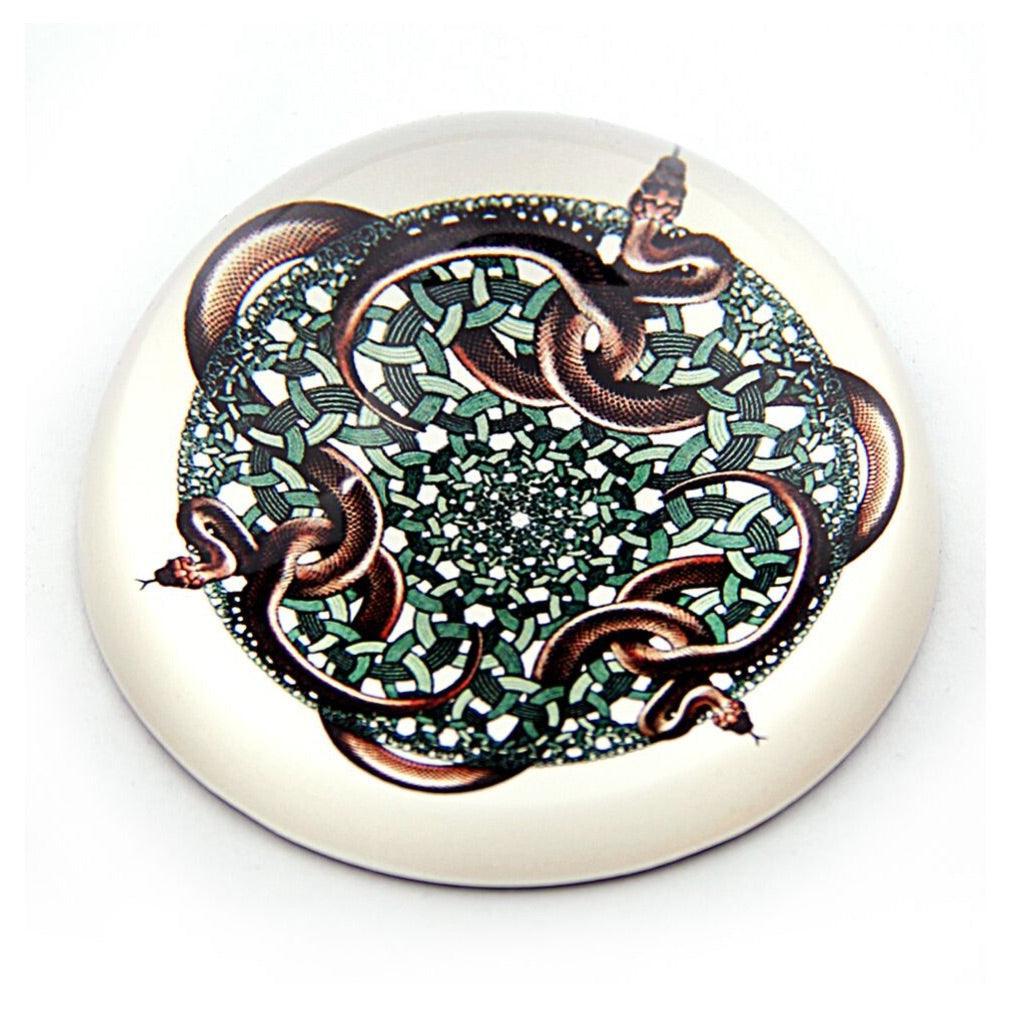
This intricate museum desk paperweight reproduces M.C. Escher’s final print, Snakes (1969). Brown serpents weave through interlocking green rings that curl inward in a continuous circular pattern. The design feels as if it could loop into infinity.
Beneath the smooth glass dome, Escher’s fine linework and repeating forms are gently magnified. The snakes appear to slide through the rings and around each other, while the pattern shrinks toward the center. This Escher desk paperweight turns your desk into a small stage for geometry, illusion, and quiet contemplation.
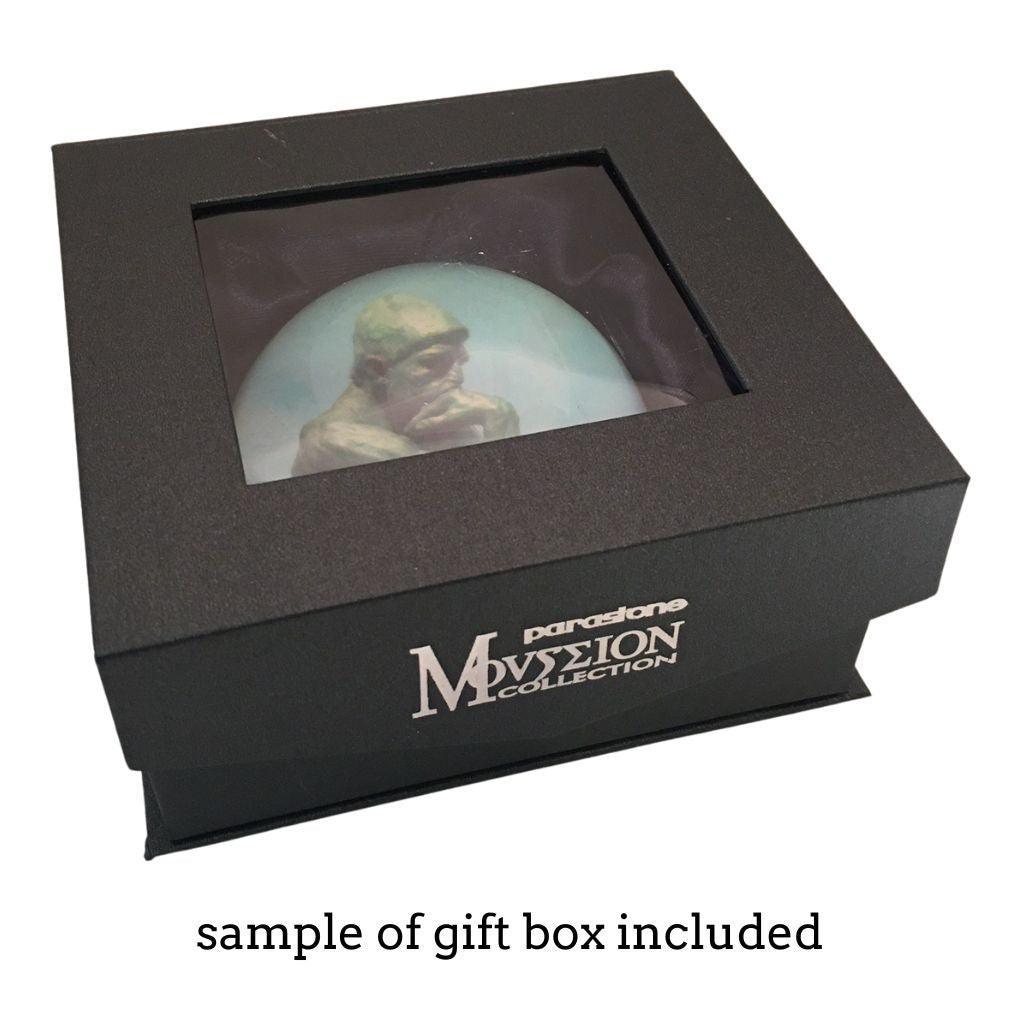
Each paperweight comes in an elegant, lined presentation box, ready for gift giving. It is ideal for mathematicians, designers, engineers, puzzle-lovers, or anyone fascinated by Escher’s visual logic. As part of the Parastone Museum Gift Collection, it translates a landmark print into a collectible object you can enjoy every day.
- Glass dome museum art paperweight with Escher’s Snakes (1969) beneath clear glass.
- Design based on Escher’s final woodcut print exploring infinity and transformation.
- Measures approx. 3 in W × 3 in L × 1.5 in H.
- Weight about 0.9 lbs, ideal for daily desk use.
- Comes in an elegant lined presentation box.
- Part of the Parastone Museum Gift Collection. PN PESC3.
About the Artwork: Escher’s Final Print
Snakes was printed in 1969 using the traditional woodcut technique that Escher refined throughout his career. Interlocking rings and coiling snakes spiral inward, suggesting endless motion within a finite circle. The shrinking forms hint at infinite regress, a theme that links geometry, time, and perception.
The print reflects Escher’s lifelong interest in infinity, symmetry, and spatial paradox. Here, the creatures move through a structure that seems both ordered and impossible. On this museum desk paperweight, the curved dome enhances that effect, making the pattern feel like it continues just beyond the surface.
About the Artist: M.C. Escher (1898–1972)
Maurits Cornelis Escher was born in Leeuwarden in the Netherlands. He first studied architecture, then turned to graphic arts under S. Jessurun de Mesquita in Haarlem. His prints bridge art and mathematics, translating ideas like symmetry, reflection, and tessellation into compelling images.
After the mid-1930s, Escher increasingly focused on impossible constructions, repeating patterns, and visual paradoxes. His work inspired mathematicians, scientists, and artists alike. Today, Escher is one of the most recognized printmakers of the twentieth century, and pieces like this Escher paperweight keep his intricate worlds close at hand.
Creating an Escher-Inspired Desk Display
This museum desk paperweight pairs beautifully with other Escher items for a coordinated, geometric desk set. You can create a small corner that feels playful, thoughtful, and slightly mind-bending.
- Explore our full Escher collection: Escher Tessellations Collection
- Add a three-dimensional companion piece: Angels & Devils Sphere Tessellation Orb
- Complete the set with matching drink coasters: Escher Museum Drink Coaster Set
Together, these pieces create a small display that celebrates logic, pattern, and Escher’s unique way of seeing the world.
Curator’s Note
Some desk objects are simply decorative. This one invites you to look closer. The half-dome desk paperweight with Snakes rewards repeat viewing, revealing new pathways and patterns each time. It is a thoughtful gift for anyone who likes art that sparks curiosity as well as conversation.
Further Reading & Context
FAQs
Got a question? We are here to answer