


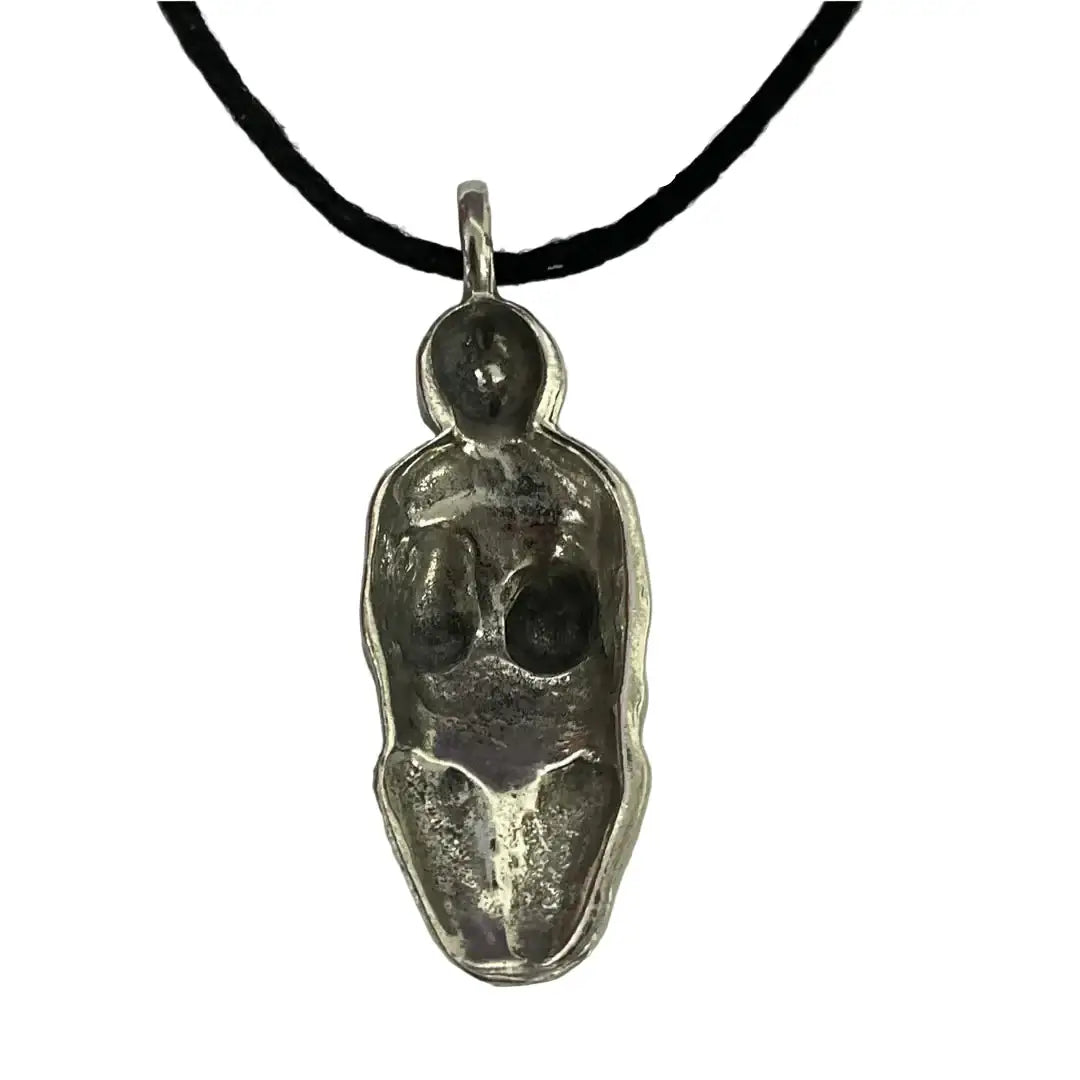
Venus of Willendorf Fertility Mother Goddess Pendant Charm Necklace 1.5L
Venus of Willendorf Fertility Mother Goddess Pendant Charm Necklace 1.5L
SKU:ETM-505
In stock
Couldn't load pickup availability
This Venus of Willendorf necklace carries one of the oldest stories in human history. The original figurine was carved from limestone roughly 25,000 to 30,000 years ago. She predates the wheel. She predates writing. She predates every religion with a name. This lead-free pewter pendant faithfully reproduces her form — the rounded belly, the full breasts, the patterned head — on a 1.5-inch charm worn on a 33-inch black cord. She is ancient. She fits in your palm. And she still has things to say.
The Venus of Willendorf pendant is one of our most beloved pieces of museum jewelry. It appeals to collectors of prehistoric art, students of mythology, spiritual seekers, and anyone drawn to the deep roots of human creativity. She is a conversation piece. A personal talisman. A connection to something 25,000 years older than anything else you own.
- Medium: Fine lead-free pewter pendant. Add to your own necklace or make a beaded necklace for a special occasion.
- Dimensions: 1.5 in L × 0.5 in W. NOTE: back side is hollow.
- Cord: 33-inch black cord.
- SKU: ETM-505.
- Explore more prehistoric art: View the Prehistoric Art Collection.
- Explore more Mother Goddess pieces: View the Mother Goddess & Fertility Collection.
The Venus of Willendorf — The World's Most Famous Prehistoric Sculpture
The original Venus of Willendorf is a tiny limestone figurine. She stands just 4.4 inches tall. She was discovered on August 7, 1908, during an archaeological excavation near the village of Willendorf in Lower Austria. A workman named Johann Veran spotted her among the excavated soil. The lead archaeologist, Josef Szombathy, photographed the findspot on the spot. Nobody had seen anything quite like her before.
She is carved from oolitic limestone tinted with red ochre. Here is the remarkable part: that type of limestone does not exist anywhere near Willendorf. In 2022, scientists used micro-CT scanning to trace the stone's origin. The closest match was near Lake Garda in northern Italy — more than 400 miles away. Someone carried her across the Alps. On foot. During the Ice Age. That single fact tells you everything about how much she mattered. The original figurine now lives at the Natural History Museum in Vienna. This Venus of Willendorf necklace brings her story with you wherever you go.
What Does the Venus of Willendorf Mean? Fertility, Survival, and Open Questions
Scholars have debated her meaning for over a century. No written records survive. No oral tradition connects to her directly. What we have is the object itself — and what it emphasizes. Her belly, breasts, and hips are pronounced. Her arms are minimal. Her legs taper without feet. Her face has no features. Her head is covered in a pattern — possibly braided hair, possibly a woven cap, possibly a ritual ornament.
Many researchers interpret her as a fertility symbol. Others see a mother goddess. Some propose she was a good-luck talisman for Ice Age hunter-gatherers. One fascinating theory suggests she may have been carved by a woman as a self-portrait — the proportions match what a person sees looking down at their own body without a mirror. No single interpretation is conclusive. That openness is part of what makes this mother goddess charm necklace so compelling. She means something different to nearly everyone who wears her.
The Venus of Willendorf Pendant and the Ice Age Figurine Tradition
The Venus of Willendorf is not alone. Over one hundred similar female figurines have been found across Ice Age Europe. They stretch from Spain to Siberia. They date from roughly 40,000 BCE to 10,000 BCE. Archaeologists call them Venus figurines — though scholars debate whether that name is appropriate or misleading.
What unites them is intention. These are not accidental forms. The makers made choices — what to emphasize, what to simplify, what to repeat across thousands of miles and thousands of years. The body became the message. Abundance. Continuity. The power of life in a world where survival was never guaranteed. Wearing this paleolithic art jewelry is a way of participating in that tradition.
Collector Pairing Suggestions for the Venus of Willendorf Necklace
This Venus of Willendorf necklace pairs beautifully with other pieces from our Prehistoric Art Collection, especially the larger Venus of Willendorf statue for a shelf display that spans 30,000 years of human creativity at a glance. Collectors drawn to the mother goddess tradition across cultures will find deep resonance in the Mother Goddess & Fertility Collection. For broader museum jewelry to pair with this pendant, browse our full Museum Jewelry Collection.
Styling & Wearing the Venus of Willendorf Fertility Goddess Pendant
At 1.5 inches, this pendant is small but unmistakable. The 33-inch black cord wears as a long pendant necklace — dramatic on its own or layered with shorter necklaces. If you like to make your own jewelry, use it to make your own Venus of Willendorf necklace. The warm grey of lead-free pewter works beautifully against natural fabrics, earth tones, and neutral colors. She also displays well propped against a small book stand or in a shadow box with other prehistoric figures. The cord can be swapped for a chain if preferred.
Care Notes of Venus of Willendorf necklace
Pewter is a soft metal. Avoid contact with harsh chemicals, perfumes, and lotions. Wipe gently with a soft dry cloth to maintain the finish. Store separately from harder metals to prevent scratching. Do not submerge in water for extended periods.
For More Reading from the Web
- Read Britannica's concise overview of the Venus of Willendorf — her discovery, form, and the scholarly debates around her meaning: Venus of Willendorf – Encyclopedia Britannica
- Explore Smarthistory's in-depth art history analysis of the figurine and the Venus figurine tradition across Paleolithic Europe: Venus of Willendorf – Smarthistory
- Read about the 2022 micro-CT scanning research that traced the figurine's limestone to Lake Garda, Italy — a discovery that rewrote what we know about Ice Age migration: High-Tech Scans Prove Venus of Willendorf Originated in Italy – Ancient Origins


FAQs
Got a question? We are here to answer