


Isis Holding Staff Egyptian Wall Relief – Temple of Kalabsha Replica 21.5H New attic
Isis Holding Staff Egyptian Wall Relief – Temple of Kalabsha Replica 21.5H New attic
SKU:E-037SP
In stock
Couldn't load pickup availability
Ritual Presence | Isis Holding Staff Egyptian Wall Relief
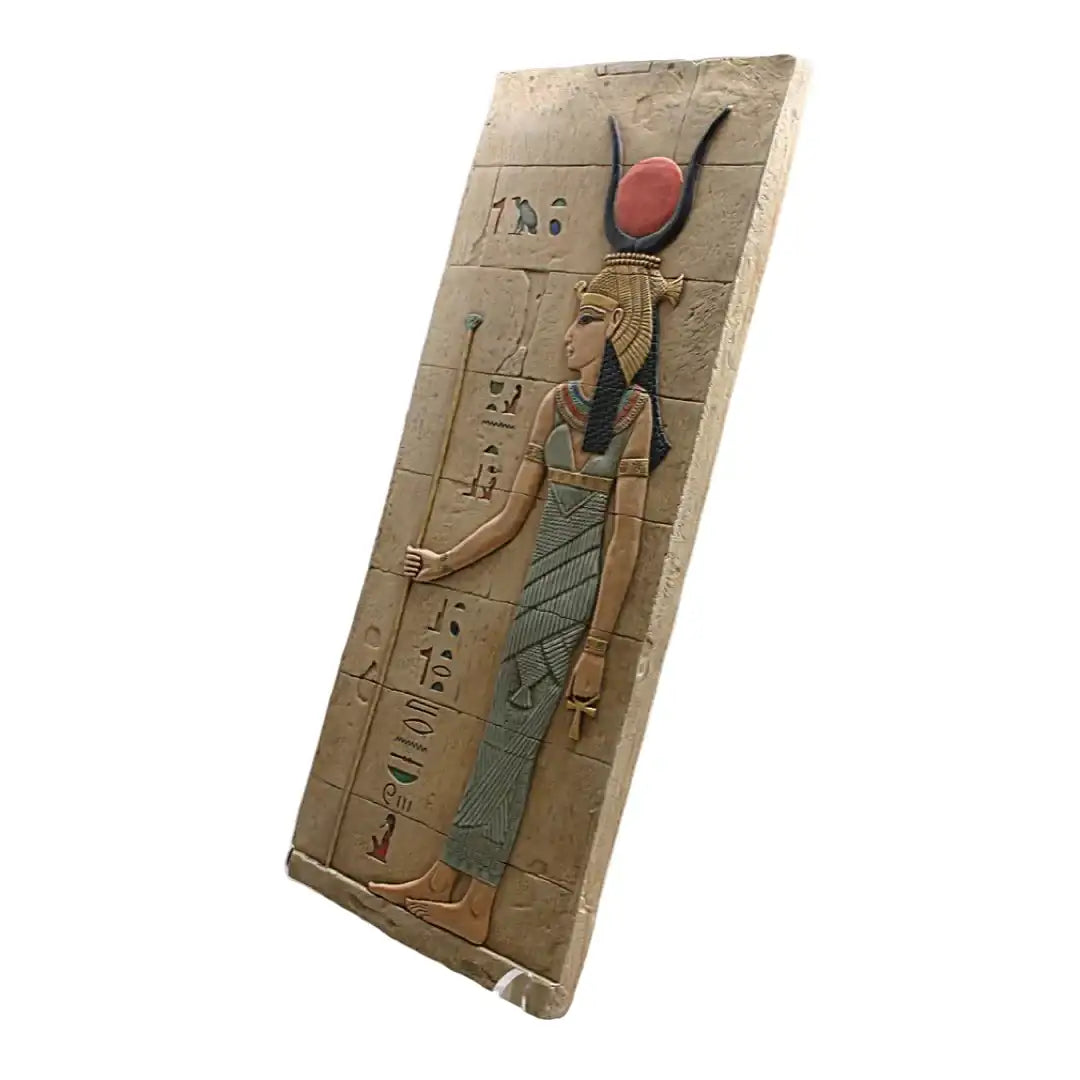
This Isis Egyptian wall relief reproduces a sacred image of the goddess as it would have appeared on an ancient tomb or temple wall. The relief is modeled after an original carving still visible at the Temple of Kalabsha in Egypt. Its surface, scale, and restraint evoke architectural sculpture rather than decorative art.
Isis appears standing in profile, holding ritual emblems associated with divine authority and protection. The figure’s calm posture and formal stance reflect Egyptian conventions for sacred imagery. This Isis Egyptian wall hanging presents the goddess as guardian, intercessor, and mother of kings.
Product Details and Features of the Isis Egyptian Wall Relief
- Museum Replica: Reproduced after an original relief at the Temple of Kalabsha, Egypt. PN E-037SP.
- Material: Bonded stone with carved surface and hand-applied color detail.
- Dimensions: 21.5 in H × 9 in W × 0.625 in D.
- Weight: Approximately 7 lbs.
- Display: Ready to hang; stand shown in images is not included.
Isis in Egyptian Religion and Royal Ideology
The name Isis means “seat” or “throne.” She was regarded as the symbolic mother of the king and a central figure in royal ideology. Through Isis, divine legitimacy passed from the gods to the pharaoh.
In myth, Isis searched for her slain husband Osiris, restored his body, and conceived their son Horus. She protected Horus from snakes, predators, and hostile forces. Because of this role, Isis was believed to extend her protection to all children and the living. This Isis Egyptian wall art reflects that protective function.
Iconography and Sacred Symbols
Isis is shown holding ritual implements associated with goddesses. The ankh symbolizes life and renewal. The papyrus scepter represents divine authority and continuity.
Her headdress combines multiple layers of meaning. The sun disk and horns connect her to Hathor. The vulture headdress identifies her with Mut. Together, these symbols express Isis’s wide authority across protection, magic, and kingship.
The Temple of Kalabsha and Its Reliefs
The Temple of Kalabsha dates to the Roman period in Nubia and was dedicated to Egyptian deities. Its reliefs preserve traditional iconography well into late antiquity. Isis appears frequently in temple contexts as a mediator between gods and humans.
Reliefs such as this one were not decorative. They functioned as permanent ritual images. Their presence activated sacred space and reinforced cosmic order. This Egyptian tomb wall relief carries that architectural purpose into a modern setting.
Craftsmanship and Architectural Presence
The bonded stone material gives the relief weight and visual authority. Subtle surface texture recalls carved limestone walls. Color accents are applied sparingly to support form rather than dominate it.
At over 21 inches tall, the relief reads as architectural rather than ornamental. It works well on a vertical wall where scale and quiet detail can be appreciated. The piece invites slow viewing and contextual understanding.
Collectible Context
This wall relief is designed for collectors interested in Egyptian religion and monumental art. It pairs naturally with freestanding figures of Isis and other deities. Together, they illustrate how Egyptian imagery functioned across sculpture and architecture.
Related works include the Isis Egyptian Mother Goddess with Wings , which presents the goddess in three-dimensional form, and other pieces in our Egyptian Art Collection .
For More Reading
- Learn about Isis’s role in myth and royal ideology at Encyclopedia Britannica: Isis .
- Explore ritual language and devotion in The Role of Speech in the Cult of Isis .
- Read an accessible overview of Egyptian mythology at Wikipedia: Isis Egyptian goddess.

FAQs
Got a question? We are here to answer