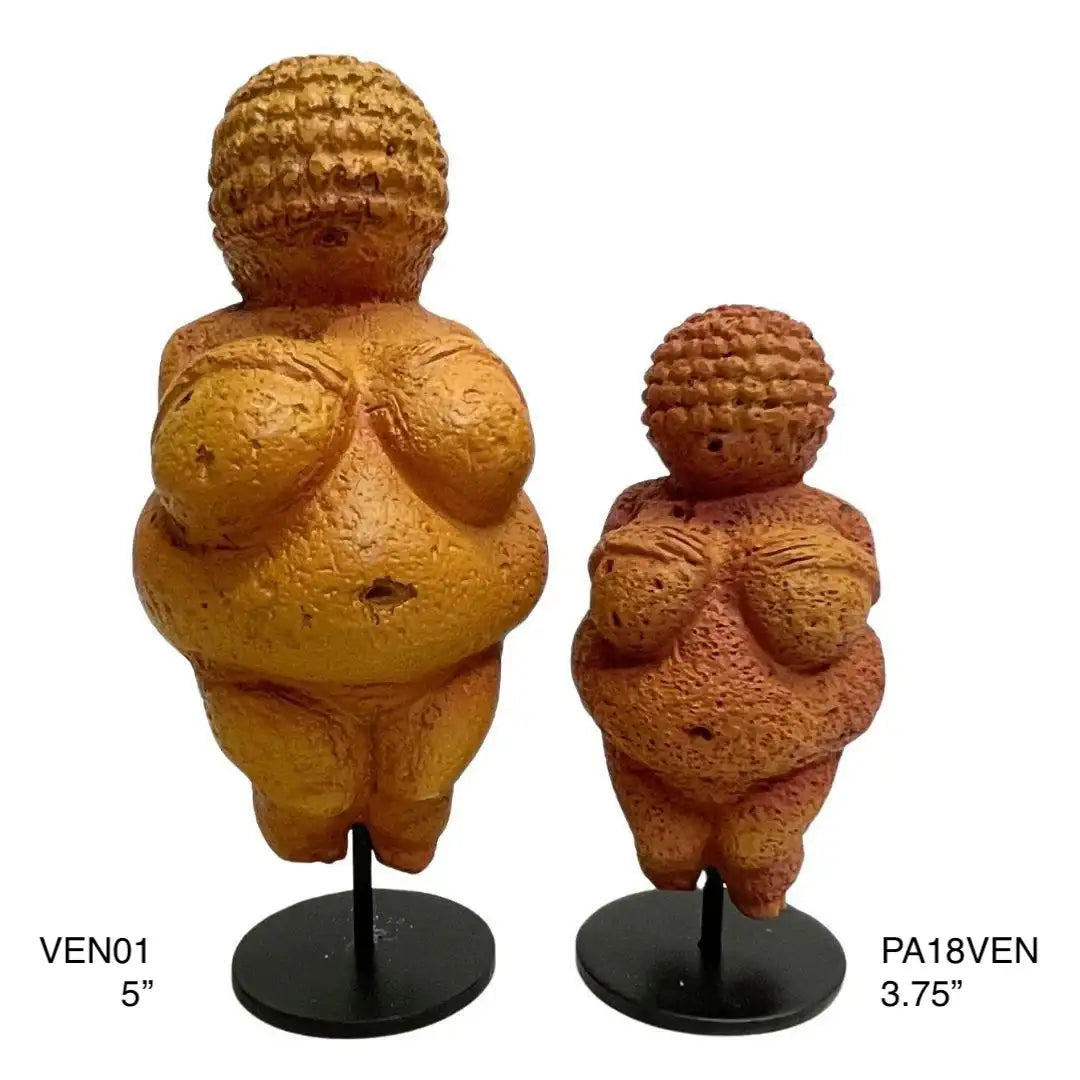
Venus of Willendorf Prehistoric Mother Goddess Statue – Paleolithic Art Replica
Venus of Willendorf Prehistoric Mother Goddess Statue – Paleolithic Art Replica
SKU:VEN01
In stock
Couldn't load pickup availability
Ice Age Beauty | Small Scale, Hold in Hand
This Venus of Willendorf statue is a museum-style replica of one of the most famous prehistoric artworks ever found. Discovered in 1908 near Willendorf in Austria, the original figure dates to roughly 24,000–22,000 BCE. It is small, but it carries big questions about symbolism, belief, and daily life in the Ice Age.
Your replica honors the original’s bold design. The body is rounded and compact. The surface suggests careful carving. The face is not individualized. Instead, the head shows a patterned texture that reads as hair, a cap, or a woven covering. This choice keeps attention on the body’s forms.
 |
ETM-505 | Pewter pendant for jewelry making of Venus of Willendorf |
What “Venus Figurines” Means
The term “Venus figurines” is a modern label. It does not reflect a prehistoric name or story. It grew from 19th-century scholarship, including the provocative nickname Venus impudique (“indecent Venus”), a pun on the classical Venus pudica pose. The label stuck, even though these objects are thousands of years older than Roman Venus.
Many Ice Age figurines exaggerate features linked to fertility and survival. That does not prove one single meaning. It does tell us what the maker chose to emphasize. This Venus of Willendorf statue keeps that emphasis clear and unapologetic.
Discovery, Material, and Why the Venus of Willendorf Statue Looks This Way
The original figurine is carved from oolitic limestone, a material not native to the immediate find area. That detail matters. It hints at travel, trade, or transport of valued stone in the Upper Paleolithic. Traces of pigment have also been discussed in scholarship, suggesting the figure may once have been colored.
The sculpture’s design is not “anatomy class.” It is visual storytelling. The arms and legs are reduced. The face is minimized. The torso and hips carry the meaning. The result is unforgettable. It is also a reminder that prehistoric artists made strong style choices.
What It Might Have Meant
No one knows the exact purpose of the Willendorf figure. That mystery is part of its power. Researchers have proposed many interpretations: a fertility symbol, a protective figure, a teaching object, or a social emblem. Some theories connect body size to survival value in harsh climates. Others focus on identity, rites of passage, or community belief.
A helpful way to frame it is this: the figure may not represent “one woman.” It may represent an idea. Abundance. Continuity. Life. In that sense, the Venus of Willendorf statue becomes less like a portrait and more like a symbol.
Product Details
- Item: Venus of Willendorf (PN VEN01). Also available smaller PA18VEN
- Material: Resin with rust-stone finish
- Display: Removable black metal stand
- Included: Color description card (four languages)
- Size: 5 in H x 2.75 in W x 2.25 in D (including stand)
- Figure height: approx. 4.5 in without stand
How Collectors Display It
This Venus of Willendorf statue displays beautifully on a bookshelf, desk, or niche. The removable stand gives you options. Use the stand for a “museum label” look. Or display the figure alone for a more intimate feel.
Many collectors build a small “prehistory shelf” to show variety in Ice Age art. A natural pairing is the Venus of Lespugue, which offers a different kind of abstraction and silhouette.
Explore Related Collections
- Shop more fertility and goddess imagery in our Mother Goddess and Fertility collection.
- Browse more early human creativity in our Prehistoric Art collection.
- Add a complementary portrait-style piece with the Lady of Brassempouy miniature.
For More Reading
- Natural History Museum Vienna context for Ice Age art (includes Willendorf): Prehistory Room Display
- PubMed Central, perspective from a medical professional: Obesity as Survival Symbol
- Clear art-history overview and interpretation notes: Khan Academy: Venus of Willendorf
- Broader background on the “Venus figurine” category: Wikipedia: Venus figurines overview
- Artist Assorted
- In Stock Museum Gifts | Ready to Ship Art & Collectibles
- Last Minute Gift Ideas: Art, History, and Museum Favorites
- Mother Goddess Fertility
- Museum Learning Tools for Art & History Education
- Museum Statues
- Nudes Human Form Studies
- Parastone Museum Replicas and Art Sculptures
- Prehistoric Art | Mother Goddesses
- Size Miniature Under 4 in
- Size Small 4 to 11 in
- Statues