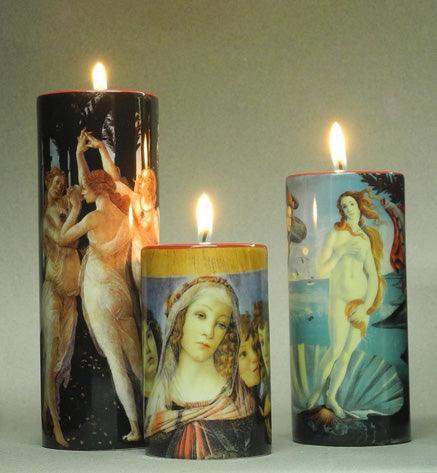
Botticelli Candle Holders Venus Spring and Madonna Ceramic Tea Light Trio
Botticelli Candle Holders Venus Spring and Madonna Ceramic Tea Light Trio
SKU:TS03BO
In stock
Couldn't load pickup availability
Botticelli Candle Holders Featuring Venus, Spring and the Madonna
Three painted women stand in a row on these Botticelli candle holders. They are Spring, Venus and the Madonna.
This ceramic tea light set has cylinders 2 in across, rising to 3.25, 4.4 and 5.9 in tall. The art covers every side.
Product Details
- Material: Ceramic, vibrant artwork printed on all sides
- Set: Three candle holders: Spring, Venus and Madonna
- Dimensions: 3.25 in H, 4.4 in H and 5.9 in H, each 2 in diameter
- Weight: 1.2 lbs
- Includes: Three tea light candles and a full-color description card
- Product number: TS03BO
Venus and Spring
Sandro Botticelli painted The Birth of Venus in Florence in the 1480s. It shows Venus arriving on a shell, blown toward shore by the west wind, Zephyr.
Smarthistory points out how unusual the picture was for its time. Its subject is fully pagan and mythological, not biblical.
His Primavera painting, called Spring, dates to about 1482. Both paintings hang in the Uffizi Gallery in Florence.
Beauty With Meaning
Botticelli also painted many Madonnas and altarpieces. The Madonna on this set shows the sacred side of his art.
Renaissance thinkers in Florence linked beauty and love to ideas of the divine. That is why goddesses and Madonnas can share these Botticelli candle holders.
Some collectors set them on an altar or meditation shelf.
Browse more Italian masterpieces in our Renaissance collection, or visit the Parastone Museum Collection.
Display and Care
Arrange the Botticelli candle holders by height with the tallest at the back. Use only tea lights, and keep them on a heat-safe surface.
A Word on Botticelli
Alessandro di Mariano Filipepi, called Botticelli (about 1445-1510), worked in Florence all his life. He also painted part of the Sistine Chapel walls.
His flowing line and luminous figures became hallmarks of the Early Renaissance.
For More Reading from the Web
- Join two art historians in front of the Venus and hear what the painting may mean. A-level: Sandro Botticelli, The Birth of Venus - Smarthistory