


Monet Water Lilies Vase | Small Ceramic 7H
Monet Water Lilies Vase | Small Ceramic 7H
SKU:VAS05MO
In stock
Couldn't load pickup availability
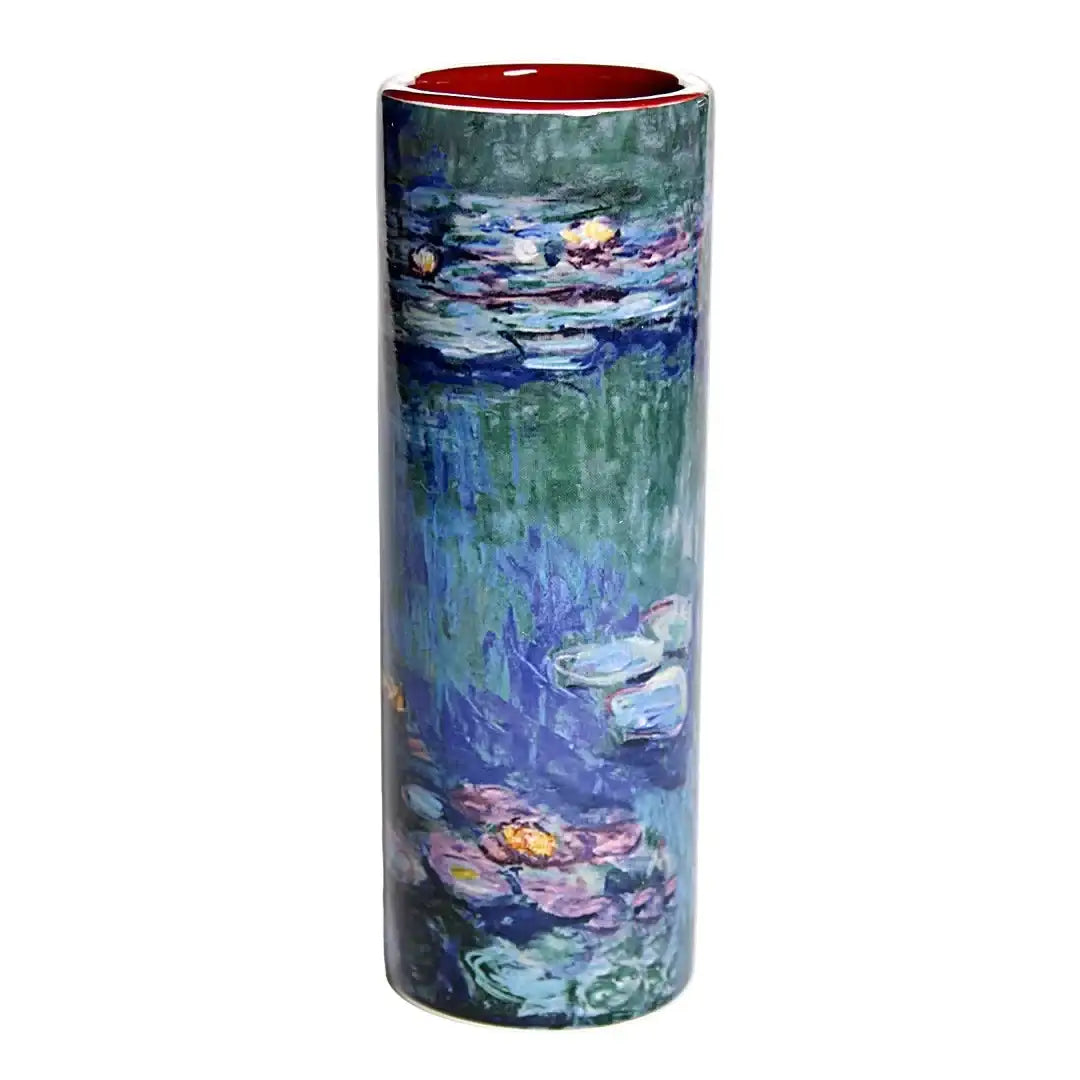
This Monet Water Lilies vase features Claude Monet’s painting Les Nymphéas (1916) reproduced in full color around a small ceramic flower vase. The surface is wrapped in floating waterlilies and lily pads, capturing the soft movement of light across the water, which became one of Monet’s defining subjects.
The lush blues and greens create a calm, atmospheric effect. Designed for desktop display, this compact vase is ideal for a few flower buds or a small arrangement. Even without flowers, the wraparound image reads like a miniature panorama of Monet’s garden at Giverny.
- Artwork: Water Lilies (Les Nymphéas), 1916
- Material: ceramic with four-color printed artwork
- Size: 7 in H × 2.5 in W × 2.5 in D
- Weight: approx. 14 oz
- Collection: Parastone Museum Gift Collection
- Product number: VAS05MO
- Includes: color description card
Water Lilies and the Language of Light
Claude Monet returned to the theme of waterlilies repeatedly in the later years of his life. At his home in Giverny, he cultivated a water garden specifically to paint it. The reflections of sky, trees, and blossoms on the pond allowed him to explore shifting light and color without fixed outlines.
Rather than defining objects with sharp edges, Monet dissolved form into atmosphere. Brushstrokes remain visible, but the emphasis is on sensation—how light changes across the surface of water from moment to moment. These paintings became central to the Impressionist movement and influenced generations of modern artists.
Claude Monet and Impressionism
Claude Monet (1840–1926) was a founding figure of the Impressionist movement. Working alongside Renoir, Bazille, and Sisley, he rejected rigid academic traditions in favor of capturing fleeting light and modern life. Painting en plein air, outdoors, allowed him to work directly from observation with rapid brushwork and luminous color.
This Monet Water Lilies vase translates that spirit into a small functional object. The circular form echoes the continuous surface of the pond, allowing the floating lilies to repeat gently as the vase is turned.
Explore more Impressionist works in our Monet, Renoir & Impressionists collection. For a taller interpretation, see the larger Water Lilies vase by Monet. You can also complement this piece with our Monet drink coasters.
Styling and Display
This small vase works best with a few fresh stems, wildflowers, or a compact arrangement. Its narrow opening supports buds without overwhelming the artwork. It also displays beautifully on its own as a miniature art object.
Care Notes of Monet Water Lilies vase
Place on a stable surface. Lift from the base when moving. Clean with a soft, dry cloth. Avoid abrasive cleaners.
For More Reading from the Web
- Art Institute of Chicago – Color, Chemistry, and Creativity in Monet’s Water Lilies
- University of Illinois Press – Monet and the Public Reception of Water Lilies
- Denver Art Museum – Water Lily Pond
The Many Versions of Water Lilies
Monet did not paint just one Water Lilies canvas. Over the final three decades of his life, he created more than 250 paintings devoted to his water garden at Giverny. Some are intimate studies of floating blossoms and reflections. Others are vast panoramic works that surround the viewer in shifting light and color.
Beginning in the 1890s, Monet became increasingly absorbed in capturing subtle changes in atmosphere. He painted the same pond at different times of day, in different seasons, and under different light conditions. Later works grow larger and more immersive, with horizon lines disappearing entirely. The water’s surface becomes sky, reflection, and abstraction at once.
Monet’s House and Garden at Giverny
In 1883, Monet settled in Giverny, where he designed and cultivated the garden that would become his greatest subject. He imported water lilies from Japan and constructed a Japanese-style footbridge over the pond. The garden was not simply a backdrop; it was a carefully composed living studio.
Monet arranged plantings for staggered blooms so that something would always be flowering. The garden became an environment of color experiments, seasonal rhythm, and observation. Many of the great Water Lilies panels now displayed in museums around the world originated from this private landscape.
A Personal Favorite: Monet’s Table
For those who love Monet’s garden as much as his paintings, we especially enjoy Monet’s Table: The Cooking Journals of Claude Monet by Claire Joyes (Hardcover, May 15, 1990). The book offers recipes inspired by the artist’s household at Giverny, alongside stories about daily life in the garden. It brings another dimension to the world that inspired the Water Lilies series.
This Monet Water Lilies vase connects to that larger story. It reflects not just one painting, but an entire environment—a cultivated garden, a life devoted to observing light, and a body of work that helped shape modern art.



FAQs
Got a question? We are here to answer