


Scarf - Emperor Huizong of Song Auspicious Cranes Square Faux Silk, 35.5 in
Scarf - Emperor Huizong of Song Auspicious Cranes Square Faux Silk, 35.5 in
Share this product
Scarf - Emperor Huizong of Song Auspicious Cranes Square Faux Silk, 35
Nine Hundred Years of Imperial Elegance — On Your Shoulders In the year 1112 CE, a flock of cranes appeared above the imperial palace in Bianjing, the capital of the Song Dynasty, circling in the sky as if performing a celestial greeting. The reigning emperor — Huizong, one of the most gifted artist-rulers in Chinese h
SKU:EV1028
In stock
Couldn't load pickup availability
Nine Hundred Years of Imperial Elegance — On Your Shoulders
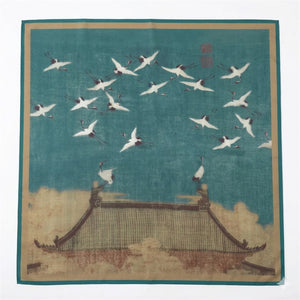
In the year 1112 CE, a flock of cranes appeared above the imperial palace in Bianjing, the capital of the Song Dynasty, circling in the sky as if performing a celestial greeting. The reigning emperor — Huizong, one of the most gifted artist-rulers in Chinese history — took it as an auspicious omen and commemorated the event in paint. The result is Auspicious Cranes: twenty red-crowned cranes soaring against a deep teal sky above the curved golden rooftops of the palace, rendered with extraordinary delicacy and precision. Two cranes perch on the roof ridge, as if pausing between worlds. It is a painting of grace, stillness, and imperial wonder.
This Emperor Huizong Auspicious Cranes faux silk square scarf honors that tradition beautifully. Made from satin polyester faux silk, the 35.5 x 35.5 inch scarf reproduces the painting's serene teal ground, the elegant white cranes with their distinctive red crowns and trailing legs, and the warm golden palace roofline in vivid, high-fidelity color on a smooth satin finish with cleanly stitched edges. Equally stunning as a neck scarf, shoulder wrap, or wall display. Visit our Museum Tote Bag Collection to find a companion piece worthy of this rare work.
An exceptional gift celebrating Chinese cultural heritage and classical court painting — and a museum-quality accessory for those who seek art beyond the Western canon.
- Material: Satin polyester faux silk
- Size: 35.5 x 35.5 inches (90 x 90 cm)
- Printed one side | Stitched edges | Satin finish | Vibrant colors
Emperor Huizong — The Artist on the Dragon Throne
Emperor Huizong of the Song Dynasty (r. 1100–1125 CE) is one of the most remarkable figures in the history of art: a reigning emperor who was simultaneously one of the greatest painters and calligraphers of his era. He founded the Imperial Painting Academy, systematized the training of court artists, and created a refined, meticulous style of court painting — known as gongbi, or "fine brushwork" — that would define Chinese figurative painting for centuries.
Huizong's paintings are characterized by their extraordinary attention to naturalistic detail, precise line, and delicate color. He painted birds, flowers, and animals with a scientific exactitude that Western art would not approach for another five centuries. Auspicious Cranes belongs to a tradition of Chinese court painting in which beauty, symbolism, and imperial authority were inseparable — the crane, in Chinese culture, is a symbol of longevity, virtue, and heavenly favor. That Huizong painted these cranes himself, rather than delegating to court artists, speaks to the depth of his engagement with his craft. His reign ended in political catastrophe — the Jin Dynasty captured him and he died in captivity — but his paintings endure as some of the finest works ever created in East Asia.

