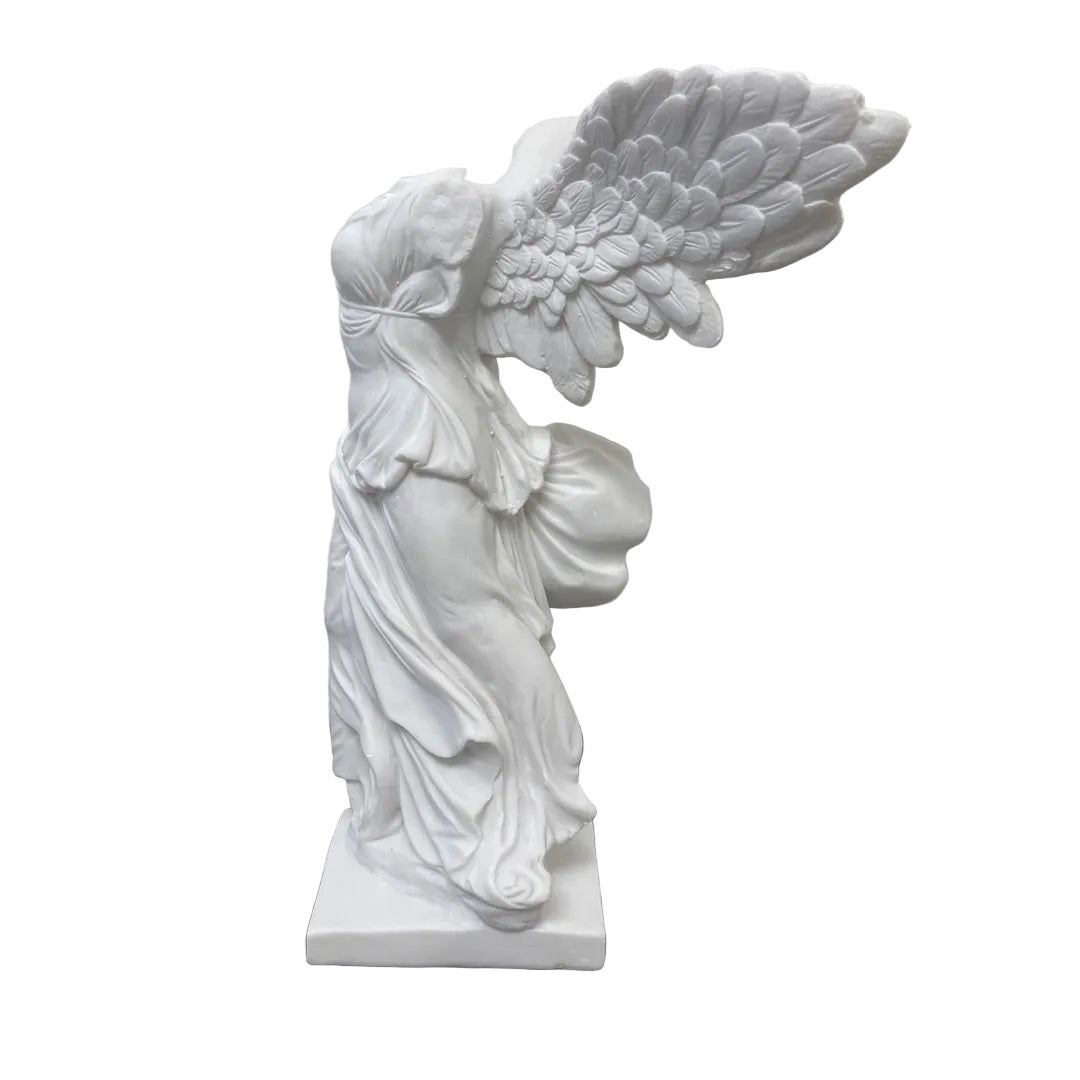


Nike Winged Greek Roman Victory of Samothrace Statue 9.5H
Nike Winged Greek Roman Victory of Samothrace Statue 9.5H
SKU:T86980
In stock
Couldn't load pickup availability
This Winged Victory of Samothrace statue is a reproduction of one of the most breathtaking sculptures in the history of Western art. Nike, the Greek goddess of victory, lands on the prow of a ship. Her wings sweep back. Her robes press against her body in the wind. She has no head. She has no arms. And she is still one of the most powerful images ever carved from stone. This white resin replica captures every fold and gesture of the Louvre original.
The original Winged Victory of Samothrace has stood at the top of the Daru staircase in the Louvre since 1883. Millions of visitors have stopped at the bottom of those stairs and simply stared. At 10 inches tall and 5.8 inches wide, this replica brings that same presence into your home.
- Medium: Resin with white finish.
- Reproduced after: The Winged Victory of Samothrace, Louvre Museum, Paris.
- Dimensions: 9.5 in H × 6.75 in W × 6 in D. Weight: 2.7 lbs.
- Product Number: T86980.
- Explore more Greek and Roman art: View the Greek & Roman Collection.
History of the Winged Victory of Samothrace Statue
The original was carved around 190 BCE from Parian marble. She originally stood on a ship's prow inside a reflecting pool at the Sanctuary of the Great Gods on the island of Samothrace. Most scholars believe she celebrated a naval victory. She was discovered in fragments in 1863 by French archaeologist Charles Champoiseau and transported to the Louvre. Her head has never been found. She has been stopping people in their tracks ever since. This Nike goddess of victory figurine carries all of that history.
Hellenistic Baroque — The Style Behind This Winged Victory of Samothrace Statue
The Victory belongs to a style art historians call Hellenistic Baroque. It replaced the calm idealism of Classical Greek sculpture with drama, movement, and emotion. Nike is perhaps the greatest expression of this style ever achieved. Her wet drapery — fabric pressed flat against her body as if soaked by sea spray — is a virtuoso technical achievement. The contrast between pressed fabric across her torso and billowing folds behind her creates an almost impossible sense of wind and motion in solid marble. This Hellenistic Greek sculpture replica preserves every one of those contrasts.
Nike — Greek Goddess of Victory
Nike was the daughter of the Titan Pallas and the river goddess Styx. During the war between the Olympians and the Titans, she sided with Zeus. Because of that loyalty, she became a constant companion of Zeus and Athena. She appears beside them on temples, coins, and monuments across the ancient world. The Romans called her Victoria. She appeared on imperial coins, military standards, and the great temples of Rome. The concept of Nike lives on today in ways that would have made ancient sculptors smile. This Winged Victory of Samothrace sculpture connects to all of that history.
Collector Pairing Suggestions for the Winged Victory of Samothrace Statue
This statue pairs beautifully with other works from our Greek & Roman Collection. For a broader classical display, explore the Parastone Museum Collection. Those drawn to great female figures of antiquity will find strong companions in the Nudes and Human Form collection.
Styling & Display of the Nike Winged Victory of Samothrace Statue
At 10 inches tall, this is a substantial statement piece. The white finish works against nearly any background — warm wood, dark shelving, natural linen, stone. She commands the most attention on a pedestal, a mantle corner, or the end of a bookshelf. A small display column echoes the ship prow of the original and elevates her further.
Care Notes
Dust gently with a soft dry cloth or brush. Avoid water and liquid cleaners on resin surfaces. Handle with care around the wings. Keep out of direct sunlight to prevent yellowing of the white finish over time.
For More Reading from the Web
- Read Smarthistory's analysis of the sculpture and its Hellenistic context: Nike (Winged Victory) of Samothrace – Smarthistory