


Aphrodite Maiden Goddess Classical Bust Statue – Ancient Marble Finish 12H
Aphrodite Maiden Goddess Classical Bust Statue – Ancient Marble Finish 12H
SKU:T87940
In stock
Couldn't load pickup availability
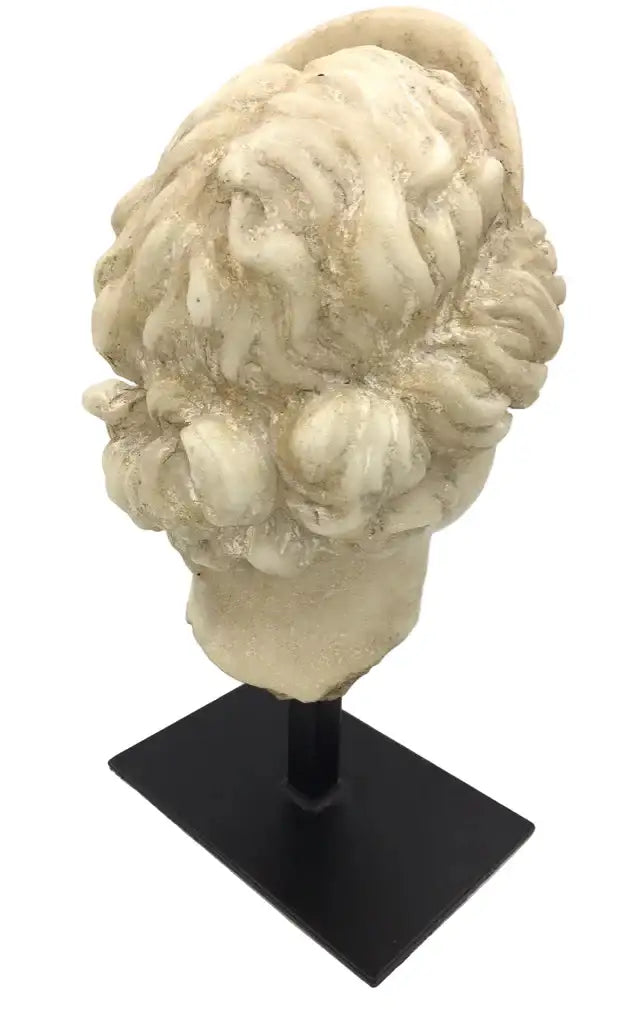
This Aphrodite bust statue is designed to look like a fragment rescued from antiquity. The bonded stone surface mimics aged marble — mottled, cool, and worn at the edges. The maiden turns her gaze gently to one side. Her features are serene and idealized in the classical Greek tradition. She rests on a removable black display stand that elevates her to the status of a museum object rather than simply a decorative piece. At 12 inches tall, she has real presence.
The aged finish on this Greek goddess Aphrodite bust is intentional. Ancient marble busts survive to us as fragments — chipped, worn, and stripped of their original paint. That incompleteness has become part of their beauty. This replica captures that quality. She looks as though she belongs in a vitrine at the Met or the Louvre — and she fits equally well on a bookshelf or writing desk.
- Medium: Bonded stone with aged marble finish.
- Dimensions: 12 in H × 6.25 in W × 6.5 in D (including stand).
- Weight: 7 lbs.
- Stand: Black display stand included. The stand is removable. PN T87940.
- Explore more Greek and Roman art: View the Greek & Roman Collection.
Who Was Aphrodite — Greek Goddess of Love and Beauty
Aphrodite was the Greek goddess of love, beauty, desire, and pleasure. Her origins are ancient and layered. Hesiod's Theogony describes her rising from the sea foam near Cyprus, born from the severed remains of the Titan Uranus. Homer's Iliad gives her a different genealogy — daughter of Zeus and the Titaness Dione. Both traditions reflect her importance: too powerful for a single origin story.
She was worshipped across the Greek world with particular devotion in Cyprus, Corinth, and Athens. As a Venus goddess sculpture, she continued under the Romans, who called her Venus and made her one of the most venerated figures in their pantheon. Julius Caesar claimed descent from her. She appears in art more than almost any other deity — on coins, temples, vases, and in sculpture from the archaic period through the Renaissance and beyond.
The Ancient Marble Bust Replica Tradition — Why Busts Matter
The portrait bust — a head and upper shoulders mounted for display — was one of the most important sculptural forms of the ancient world. Greeks and Romans used busts to honor gods, commemorate heroes, and decorate homes, libraries, and public spaces. A bust of Aphrodite or Venus in a Roman household was not unusual. It was a statement of taste, piety, and cultural aspiration.
This ancient marble bust replica draws on that long tradition. The bonded stone construction gives the piece genuine weight — at 7 lbs, this is a substantial object, not a lightweight resin figure. The surface texture rewards close inspection. The slightly averted gaze of the maiden is a hallmark of classical Greek sculpture — figures rarely meet the viewer's eye directly. They look inward, or elsewhere, as if the divine exists slightly beyond our line of sight.
Collector Pairing Suggestions for the Aphrodite Bust Statue
This Greek Roman bust collectible works naturally alongside other classical figures from the Greek & Roman Collection at Museumize. For collectors building a classical display, it pairs well with the Athena Parthenos and Nike Winged Victory statues — three goddesses, three domains of the ancient world. Browse the full Nudes and Human Form collection for additional companions in the classical tradition.
Styling & Display of the Aphrodite Bust Statue Ancient Marble Finish
The removable black stand elevates the bust and creates a clean museum-style presentation. Without the stand, the bust can rest directly on a surface for a different, more informal look. The cool grey-white tones suit natural stone surfaces, dark wood, and warm linen. She works on a bookshelf, a console, or as a standalone piece on a pedestal. At 7 lbs, she has the satisfying weight of a serious object.
Care Notes
Dust with a soft dry cloth. Avoid water and liquid cleaners on bonded stone surfaces. The aged finish is part of the design — avoid polishing, which would alter the effect. Handle with care, given the weight. Keep away from edges where tipping could cause damage.
For More Reading from the Web
- Explore Aphrodite's mythology, cult sites, and artistic tradition at the Theoi Project — a comprehensive scholarly reference on Greek mythology: Aphrodite – Theoi Greek Mythology
- Read Smarthistory's overview of ancient Greek sculpture and the classical ideal of beauty: Ancient Greek Art – Smarthistory
- Discover how the Romans transformed Aphrodite into Venus and wove her into their religious and political identity at Britannica: Venus – Encyclopædia Britannica


FAQs
Got a question? We are here to answer