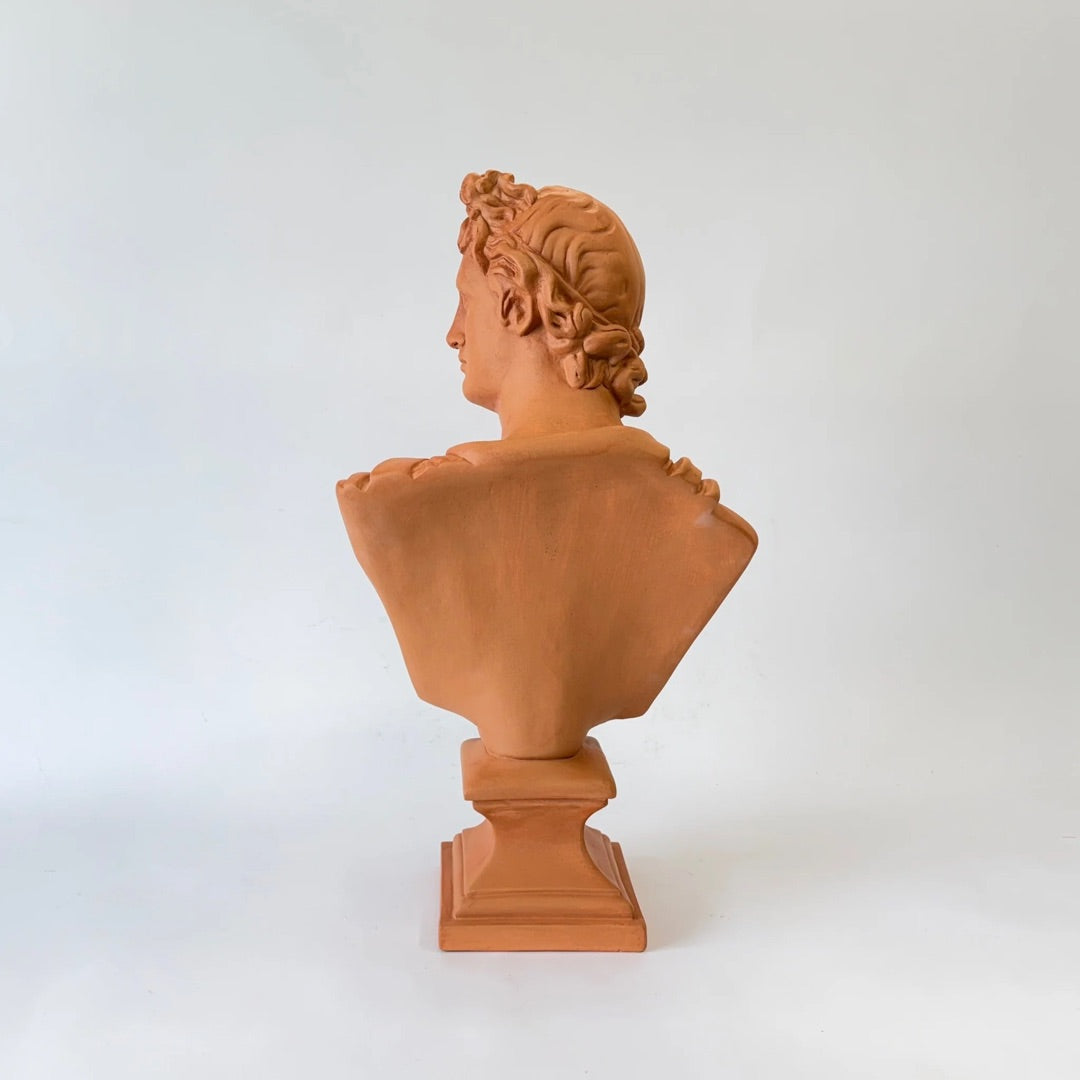
Apollo Belvedere Bust | Hand Cast Plaster 23.5H
Apollo Belvedere Bust | Hand Cast Plaster 23.5H
SKU:HP6451WHT
In stock
Couldn't load pickup availability
The Apollo Belvedere, Reproduced as a Bust
This Apollo Belvedere bust reproduces the head, neck, and shoulders of the most admired Apollo to survive from antiquity: face turned slightly to one side, lips faintly parted, curls loosely gathered and bound at the back of the head with a thin fillet. A chlamys is draped diagonally across the chest and fastened at the shoulder with a round clasp, the only garment on an otherwise bare torso. Cast in plaster and finished in white, the surface reproduces the smooth, even plane of the marble original, set on a stepped pedestal base.
At 23.5 in H, this bust brings a monumental Roman marble down to shelf- and desk-scale, keeping the fillet, the loose curls, and the chlamys clasp that identify this specific Apollo type rather than a generic idealized head.
Item Details
- Material: Hand-cast plaster, white finish
- Dimensions: 23.5 in. H x 13 in. W x 9 in. D
- Weight: 15 lb
- Production: Made to order in the USA, ready to ship in 2 to 3 weeks
- SKU: HP6451
- Related collection: Greek and Roman Collection
- Related collection: Statues Collection
We recommend pairing Apollo with our Diana Bust HP64520
The Apollo Belvedere in the Vatican Museums
The Apollo Belvedere is a marble sculpture carved sometime in the 2nd century CE, a Roman copy of a Greek bronze original made between 330 and 320 BCE. Many historians attribute the lost original to the sculptor Leochares, though the attribution is not settled and rests on indirect evidence rather than a signature. The marble copy was unearthed in 1489 among the ruins of an ancient house on Rome's Viminal Hill and bought soon after by Cardinal Giuliano della Rovere, who became Pope Julius II in 1503. In 1508, Julius II had the statue installed in the Cortile del Belvedere, the courtyard connecting the Vatican Palace to the Villa Belvedere, which gave the sculpture its name. It remains on view there today, in the Pio Clementino Museum of the Vatican Museums.
Apollo, and Why the Fillet and Cloak Matter
Apollo was the Greek and Roman god of the sun, music, healing, prophecy, and truth, and the twin brother of Diana. Ancient sculptors marked him with recurring attributes: a fillet binding unruly curls and a light cloak rather than full dress. In the complete statue, the god's now missing left hand is thought to have held a bow, and the Apollo Belvedere is traditionally read as showing him an instant after firing an arrow, caught in the calm that follows the shot rather than the tension before it. From the mid-18th century, the art historian Johann Joachim Winckelmann held up this particular Apollo as the high point of ancient sculpture, a judgment that shaped two centuries of European ideas about physical and artistic perfection, and that carried the image, through prints and casts, well beyond Rome.
Display
A bust at this scale suits a desk, mantel, or bookshelf, in keeping with the long-standing practice of displaying classical heads as markers of a home library or study. Plaster is durable but porous: keep it away from standing water and dust it with a soft, dry cloth rather than with water.
For More Reading