


Crinoid Feather Star Columnal Segments - Authentic Jurassic Morocco Fossil
Crinoid Feather Star Columnal Segments - Authentic Jurassic Morocco Fossil
SKU:80-112-0087-201-38
In stock
Couldn't load pickup availability
A Crinoid Fossil Collected as Fairy Money for Centuries
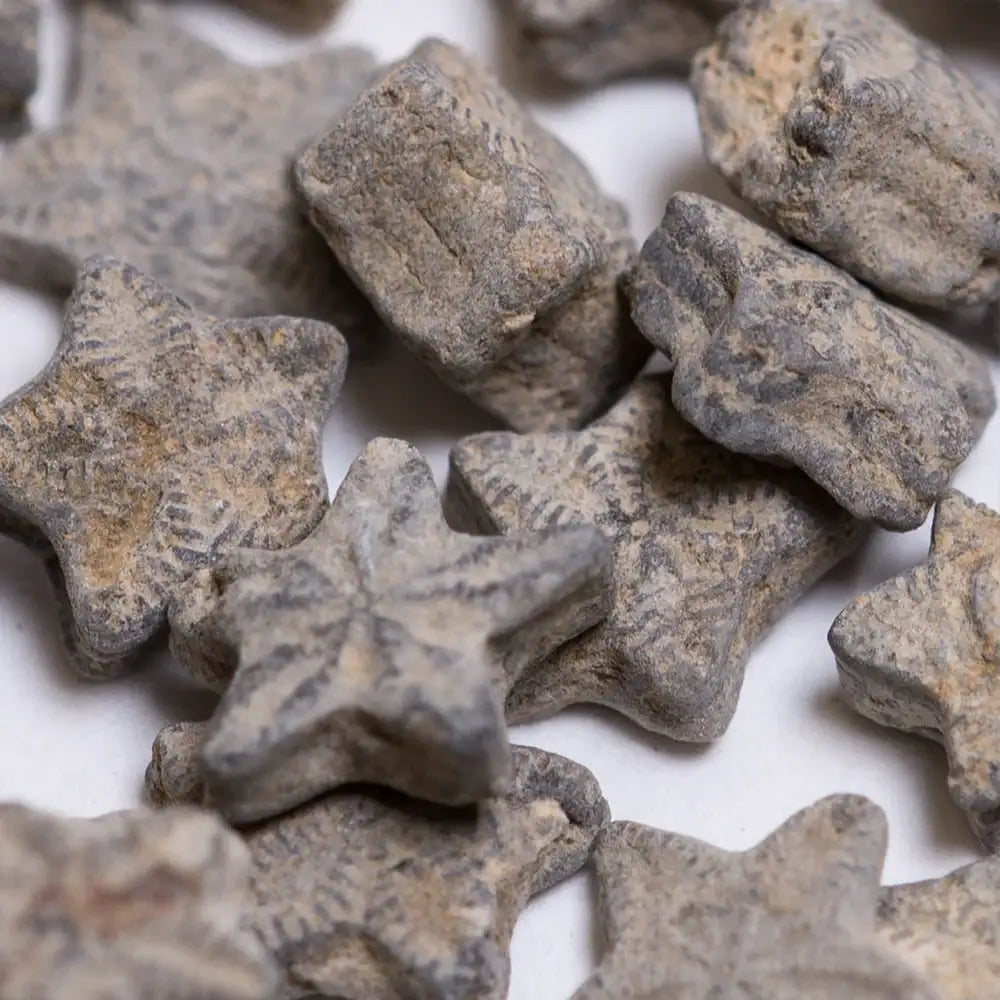
This crinoid fossil set holds five to seven stem segments of an animal called a sea lily. The segments are small, stacked discs that formed the animal's stalk. They sit in an acrylic jar inside a glass-topped riker case.
Product Details
- SKU: 80-112-0087-201-38
- Type: Crinoid stem segments, five to seven per jar
- Age: Bajocian Age, Middle Jurassic, roughly 170 million years old
- Origin: Near Talsint, Morocco, a Jurassic Morocco fossil locality
- Display: Acrylic jar in glass-topped riker case, 4.5 in x 3.5 in
- Includes: Information card that serves as the certificate of authenticity
- Note: Each sea lily fossil selection is unique
An Animal That Looks Like a Plant
Despite the name, a sea lily is an animal. It belongs to the same group as starfish and sea urchins. A stalk anchored it to the sea floor, while feathery arms trapped drifting plankton. Every crinoid fossil is proof that these animals have existed for at least 480 million years.
The stalk was built from linked discs called columnals. Each has a central hole, so together they form a hollow channel, or lumen. A crinoid fossil like this shows that anatomy at close range.
Fairy Money and Saint's Beads
Before people knew these were fossils, the segmented stems were called fairy money. In Germany they became Saint Boniface's pfennige. In England they were known as Saint Cuthbert's beads.
This Jurassic Morocco fossil comes from rock near Talsint. You can see related pieces in our Natural History Collection and our Authentic Fossil Specimens.
Display and Care
Keep the crinoid fossil case away from direct sun and damp air. The crinoid stem segments are loose in their jar, so handle it gently.
About Crinoids Today
Crinoids are not extinct. Living species still grow in the world's oceans, some on stalks and some free-swimming. A sea lily fossil like this one comes from a lineage that survived several mass extinctions.
For More Reading from the Web
- Learn how old crinoids really are, from fossils that predate the dinosaurs by hundreds of millions of years. Four-Hundred-Eighty-Million-Year-Old Fossils Reveal Sea Lilies' Ancient Roots - Field Museum
- See how the stem discs link together and what ran through the central hole. Crinoid Stem Lumen - UC Museum of Paleontology


FAQs
Got a question? We are here to answer