Dancing Woman Greek Red Figure Lekythos Vase Imported from Greece 23H
Dancing Woman Greek Red Figure Lekythos Vase Imported from Greece 23H
SKU:B005
In stock
Couldn't load pickup availability
A Greek Dancing Vase Where a Youth Leaps Toward a Crowned Woman
A woman in a flaring skirt flings out her arms while a nude youth strides toward her. This Greek dancing vase is a tall terracotta lekythos, or Greek oil flask, hand spun in Greece. It stands 23 in tall. Orange-red figures stand out against a black body with brown mottling. The neck, cup-shaped mouth, and handle are black. A silver metal seal hangs from the handle.
**THE ITEM PICTURED IS THE ITEM YOU WILL RECEIVE / ONLY 1 AVAILABLE**
Product Details
- Material: Terracotta, hand spun on the wheel
- Origin: Made in Greece
- Certification: Greek Ministry pewter seal
- Dimensions: 23 in H x 6.5 in W x 6.5 in L
- Weight: 7.7 lbs
- Original pattern: about 460 BCE, copy signed by P. Vaglis
- Style: Attic red figure
- Status: No longer manufactured, and this vase is over 30 years old
- Product number: B005
A Woman with Arms Flung Wide
She turns in profile, with both arms thrown out to the sides. Her dress flares into a wide bell, drawn with fine folds and small dots. A dotted necklace circles her throat, and cream strokes mark her bracelets. Her tall headdress is a halo of scales and pointed petals, edged with a ring of heart-shaped leaves. Nothing on the vase names her.
A Youth in Mid-Stride
The nude youth leaps toward her with one leg kicked back. One arm reaches for her shoulder, and the other rises with an open palm. A crest of spiked leaves, or feathers, rises from his headband. His pose is quick and tense.
Dance or Pursuit?
The pair could be dancing, or he could be chasing her. The Met holds a lekythos of about 460 to 450 BCE that shows Poseidon pursuing a woman. Our supplier calls this a dancing woman, and her outspread arms support that. No inscription names the figures, so we describe only what we can see. The story stays open.
Red-Figure: Drawing with the Clay
Painters of this style left the figures the orange color of the clay. They painted the background black. Fine black lines then drew the faces, hands, and folds of cloth. The method began in Athens around 530 BCE. By 460 BCE, painters drew freer bodies and calmer faces. This red figure lekythos copy follows that tradition closely.
Palmettes, Vines, and Greek Key Bands
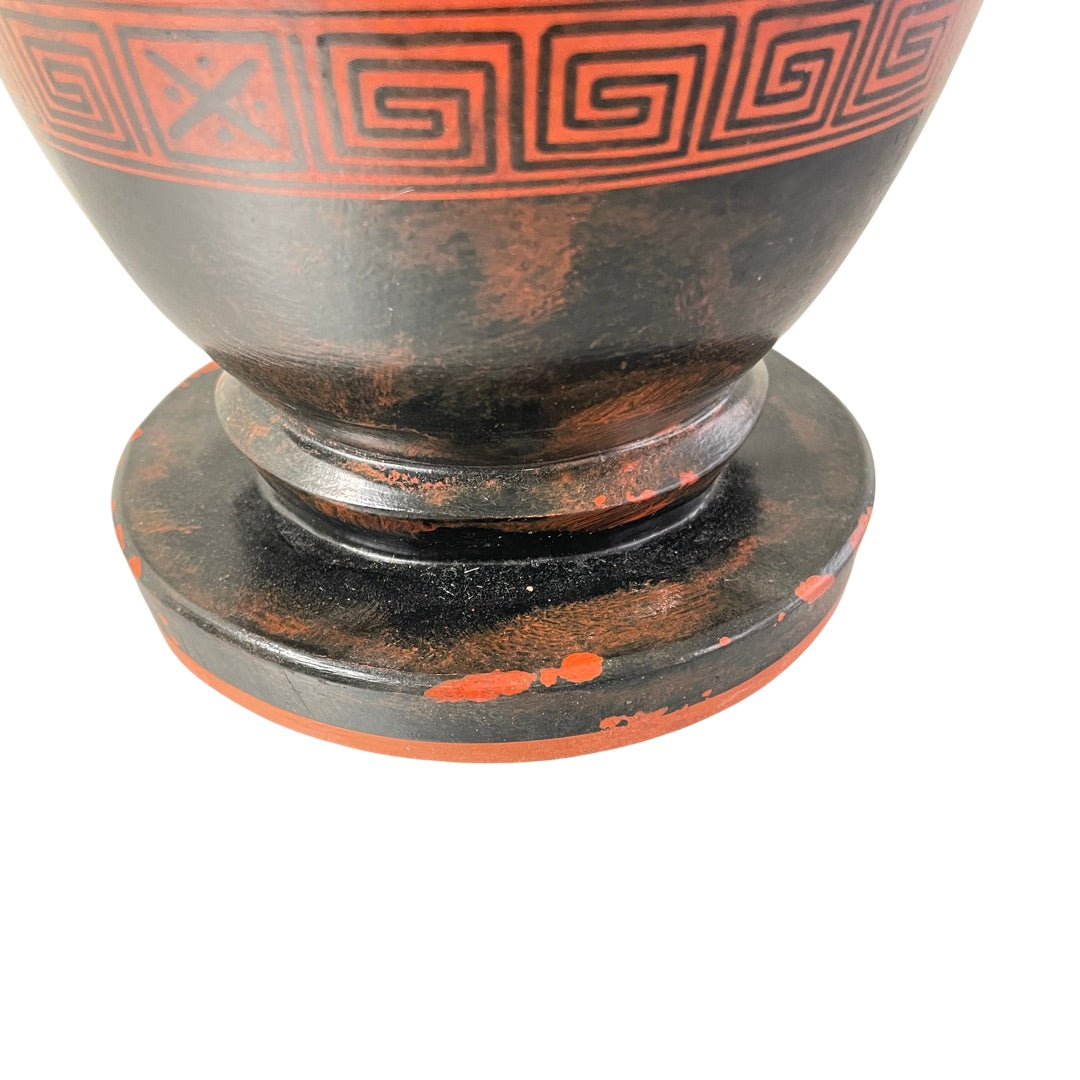
On the sloping shoulder, black palmettes and spirals spread across an orange ground, with dots between them. A band of black tongues circles the base of the neck. Two bands of Greek key meanders, broken by squares with crossed lines, frame the picture. On the back, a vine of orange palmettes and curling tendrils climbs the body. This Greek palmette vase has a quiet, patterned back.
A Flask for Oil
A lekythos held olive oil or perfume. It has a narrow neck, a cup-shaped mouth, and one handle. Brown University describes it as a small pouring vessel used in ritual and at funerals. The shape let a user pour a few drops at a time. At 23 in, this Greek oil flask is a tall copy of that small vessel.
Copied from Museum Pattern Books
The base reads Copy, hand painted by P. Vaglis, Attic Lekythos, 460 BC. Workshops in Greece reproduce these vases after pattern books of pieces held in Greek museums. This copy is not one of a kind. It is very high quality and over 30 years old. Before export, the Greek Ministry of Culture applied the metal seal on the handle.
See more painted vessels in our Greek vase collection. You can also browse our Greek and Roman collection.
Display and Care
At 23 in tall and 7.7 lbs, this Greek dancing vase needs a sturdy shelf, mantel, or table. It is tall and narrow, so keep it away from edges. Small spots of paint wear show at the foot. Dust it with a dry, soft brush. Turn it now and then to show its Greek palmette vase back.
Athens Around 460 BCE
This date falls in the Early Classical age of Athens, just after the Persian Wars. Painters moved from stiff Archaic poses toward freer, more natural bodies. Red-figure had replaced black-figure for fine vases by then. The red figure lekythos was common for oil, for ritual, and as an offering at the grave.
For More Reading from the Web
- Find out how Athenian painters drew red figures on a black ground: Athenian Vase Painting: Black- and Red-Figure Techniques - The Metropolitan Museum of Art
- See how a university collection explains the lekythos as a pouring flask: Red-figure Lekythos - Joukowsky Institute, Brown University
- Watch a woman dance for winged Eros on a Met red-figure oil flask: Squat Lekythos: Eros and a Woman - ISAW, New York University