


Degas Ballerina Waiting Statue L'Attente Museum Replica
Degas Ballerina Waiting Statue L'Attente Museum Replica
SKU:DE02
In stock
Couldn't load pickup availability
Authentic Movement | Degas Ballerina Waiting Statue
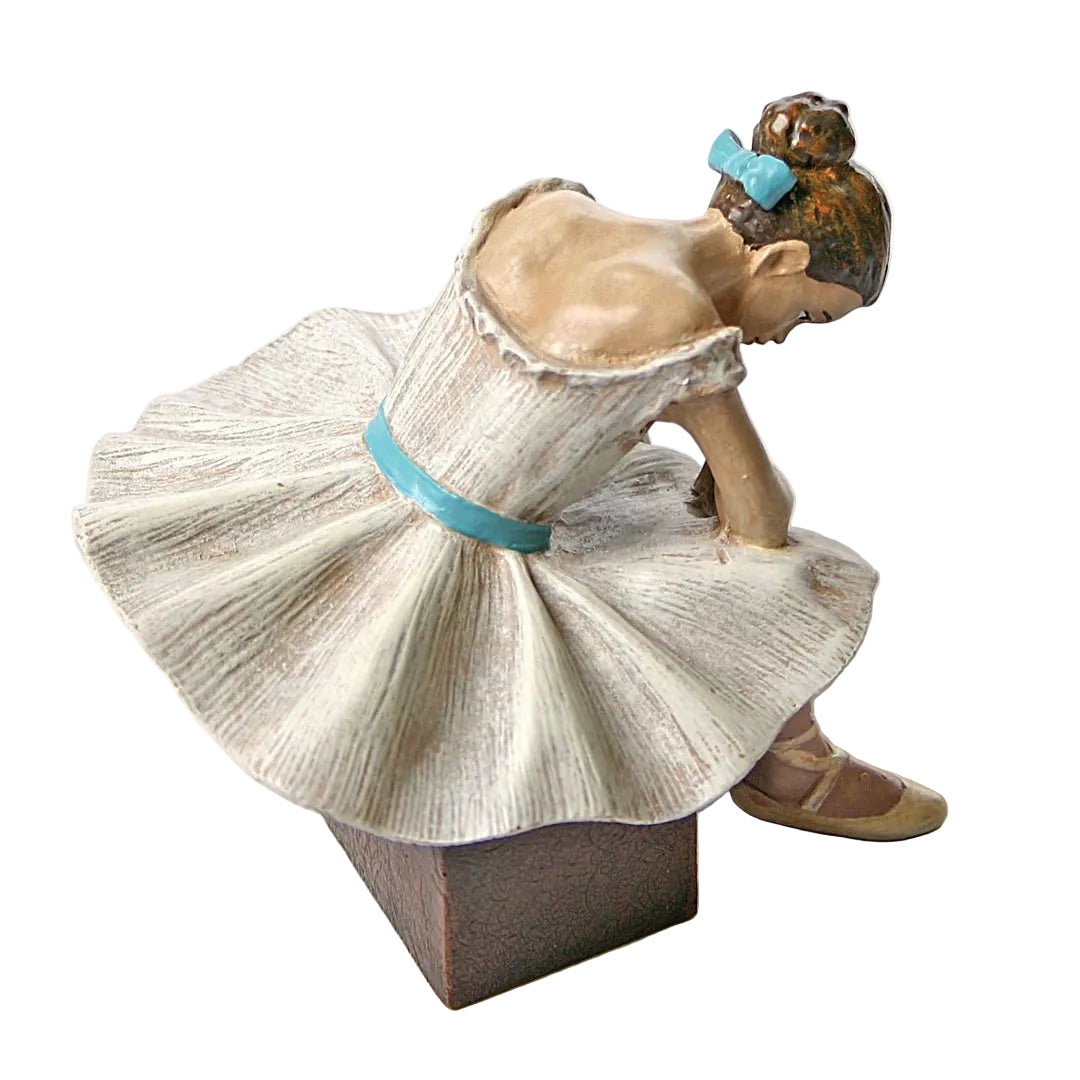
This striking Degas ballerina waiting statue captures a moment of exhaustion and vulnerability. A young dancer rests between rehearsals or auditions, her hand reaching toward her weary ankle. Her tutu cascades around her, but there is no grace in this pose. This is the unglamorous reality of backstage life—the physical toll that audiences never see. For nearly fifty years, Edgar Degas documented this hidden world with unflinching honesty.
Hand-painted with airbrushed detail, the L'Attente ballerina sculpture renders the fabric of her tutu and the delicate line of her neck with extraordinary sensitivity. At 4 inches tall and weighing just 0.8 pounds, this museum replica fits comfortably on a shelf or desk yet commands attention through its emotional presence. The figure seems to hold her breath, waiting. Waiting for her name to be called. Waiting for her chance.
This Edgar Degas ballet figurine represents one of the artist's most compelling themes: the life of young chorus dancers in Paris. Unlike romanticized portrayals of ballet, Degas showed the physical exhaustion, the awkward poses, and the moments between performances when the illusion fades. As part of the Parastone Museum Collection, this replica honors Degas's revolutionary approach to capturing the human body in both motion and rest.
- Degas ballerina waiting statue (L'Attente), hand-painted resin with airbrushed details
- Young chorus dancer resting, hand grabbing weary ankle, waiting for audition or rehearsal
- Based on Degas's 1882 painting and subsequent sculptures
- Measures 4 in H x 4 in W x 3.5 in D
- Weight 0.8 lbs, suitable for shelf or desk display
- Includes full-color description card
- Part of the Parastone Museum Collection. PN DE02
About the Artwork: L'Attente (The Waiting, 1882)
L'Attente emerged from Degas's decades-long obsession with the world of Parisian ballet. The work captures a single moment of profound vulnerability: a young ballerina, no star, just a chorus member, rests while waiting for her next call. Her body speaks of exhaustion. Her hand reaches toward her ankle—the tool of her trade, worn and aching.
The composition is radical. There is no stage lighting, no romantic presentation. The setting is bare, intimate, almost clinical in its honesty. Degas refused to beautify or sentimentalize the dancer's experience. Instead, he documented the physical reality: the strain on muscles and joints, the mental fatigue of repetitive training, the anxiety of waiting for opportunity. This L'Attente ballerina sculpture translates that visual honesty into three dimensions.
The painting and sculpture versions of L'Attente represent Degas at his artistic maturity. He had spent a decade sketching Paris dancers in rehearsal studios and backstage areas. He had earned their trust and access to spaces most artists never saw. This work, and the hundreds of ballerina studies that followed, became his life's work.
About the Artist: Edgar Degas (1834-1917)
Edgar Degas was a founder of French Impressionism alongside Claude Monet, yet his work diverged dramatically from the purely landscape-focused work of other Impressionists. Degas was obsessed with human movement—particularly the movement of ballet dancers. Beginning in the 1870s, he spent a decade sketching young women training in Parisian ballet studios. Those initial sketches became a goldmine of inspiration for the next forty years.
Over his lifetime, Degas created more than 1,500 artworks featuring ballerinas: paintings, drawings, monotypes, prints, and sculptures. Each work captured a different moment, a different angle, a different emotional truth about the dancer's life. He was not interested in idealized beauty. He was fascinated by authenticity—how bodies actually moved, how fabric actually draped, how fatigue actually manifested in a face and posture.
Degas's ballerina sculptures, such as L'Attente, were created late in his career, often from earlier painted studies. They allowed him to explore form and shadow in three dimensions, to understand the dancer's body from every side. His late sculptures, executed largely by his assistants after his eyesight failed, are considered among his most psychologically penetrating works.
The Chorus Dancer: Degas's True Subject
While romantic narratives celebrate the prima ballerina, Degas focused his artistic attention on the chorus dancers. These were young women, often poor, training for years with little guarantee of advancement. They performed in corps de ballet roles, held extra rehearsals, endured physical discipline, and waited for their rare solo opportunities. Their lives were marked by hope and frustration in equal measure.
In L'Attente, Degas captures this tension perfectly. The dancer sits not on stage but in a rehearsal space, waiting. She is not performing for an audience. She is simply existing in the space between training and performance, between anonymity and recognition. This moment—this waiting—became, for Degas, the truest expression of what it meant to be a dancer.
For collectors today, this Edgar Degas ballet figurine offers a window into that hidden world. It honors the thousands of chorus dancers whose names were never recorded but whose lives inspired one of history's greatest artists.
Curator's Note
When you hold this Degas ballerina waiting statue, you hold an object that Degas himself might have held and studied. His sculptural process involved physical manipulation, turning the form in his hands, understanding it from every angle. The hand reaching toward the ankle, the weight of the body pressing downward, the slight angle of the head—these are not romantic gestures. They are gestures of fatigue and hope. They are the truest things Degas ever sculpted. For collectors who understand that art reveals what we rarely see, this L'Attente replica connects you to Degas's revolutionary vision of truth in art.
For More Reading


FAQs
Got a question? We are here to answer