


Dracula's Castle Soil Coffin - Cetatea Poenari Earth on Display Card
Dracula's Castle Soil Coffin - Cetatea Poenari Earth on Display Card
SKU:80-112-0482-201-40
In stock
Couldn't load pickup availability
A Dracula Soil Coffin From the Poenari Fortress
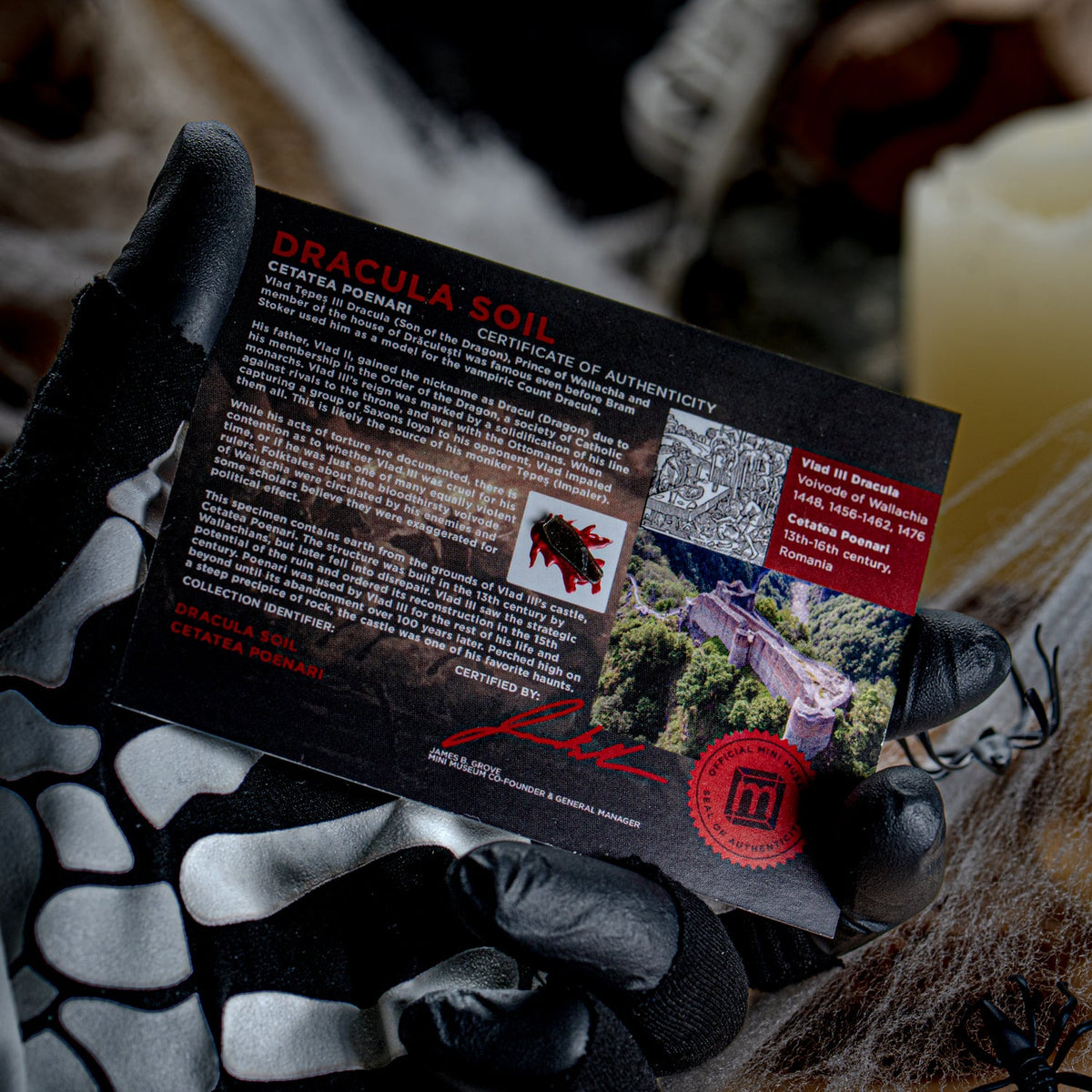
This Dracula soil coffin holds earth from Cetatea Poenari. The soil is sealed in resin and shaped like a coffin. It comes on a 4 in x 3 in card with red wax.
Product Details
- Specimen: Earth from the Poenari fortress, sealed in resin and shaped like a coffin
- Display: 4 in x 3 in card with photos and castle information
- Includes: Red wax and the Mini Museum Seal of Authenticity
- Edition: Dracula soil was part of the Mini Museum First Edition
The Fortress and Its History
Cetatea Poenari is a cliffside fortress in Romania. Wallachians built it long before Vlad III. He ordered it rebuilt in the 15th century and used it for the rest of his life.
The fortress was abandoned more than 100 years later. Earthquakes in the 20th century damaged it, and after slight repairs it still stands. Visitors climb 1,480 steps to reach it.
Vlad Tepes III and the Name Dracula
Vlad Tepes III ruled Wallachia in 1448, from 1456 to 1462, and in 1476. His father, Vlad II, was nicknamed Dracul. The nickname Impaler likely came from impaling a group of captured Saxons.
Historians debate whether he was crueler than other rulers of his time. Bram Stoker published Dracula in 1897. The link between Vlad and the vampire may be coincidental, since Stoker never visited Transylvania. Find more in our Authentic Historical Artifacts.
Display and Care
Keep the card away from heat and direct sun. Handle this Dracula castle soil sample by the card edges so the red wax stays in place.
About the Soil
Soil from the fortress ties the legend to a real place. A Dracula soil coffin turns that earth into a small, spooky keepsake. Your Dracula castle soil sample comes from a monument that visitors can still climb to.
For More Reading from the Web
- Read a short biography of the ruler behind the legend. Vlad the Impaler - Britannica
- Follow the fortress through its recent restoration. Vlad the Impaler's Fortress at Poenari Reopened After Extensive Conservation and Restoration Works - AGERPRES


FAQs
Got a question? We are here to answer