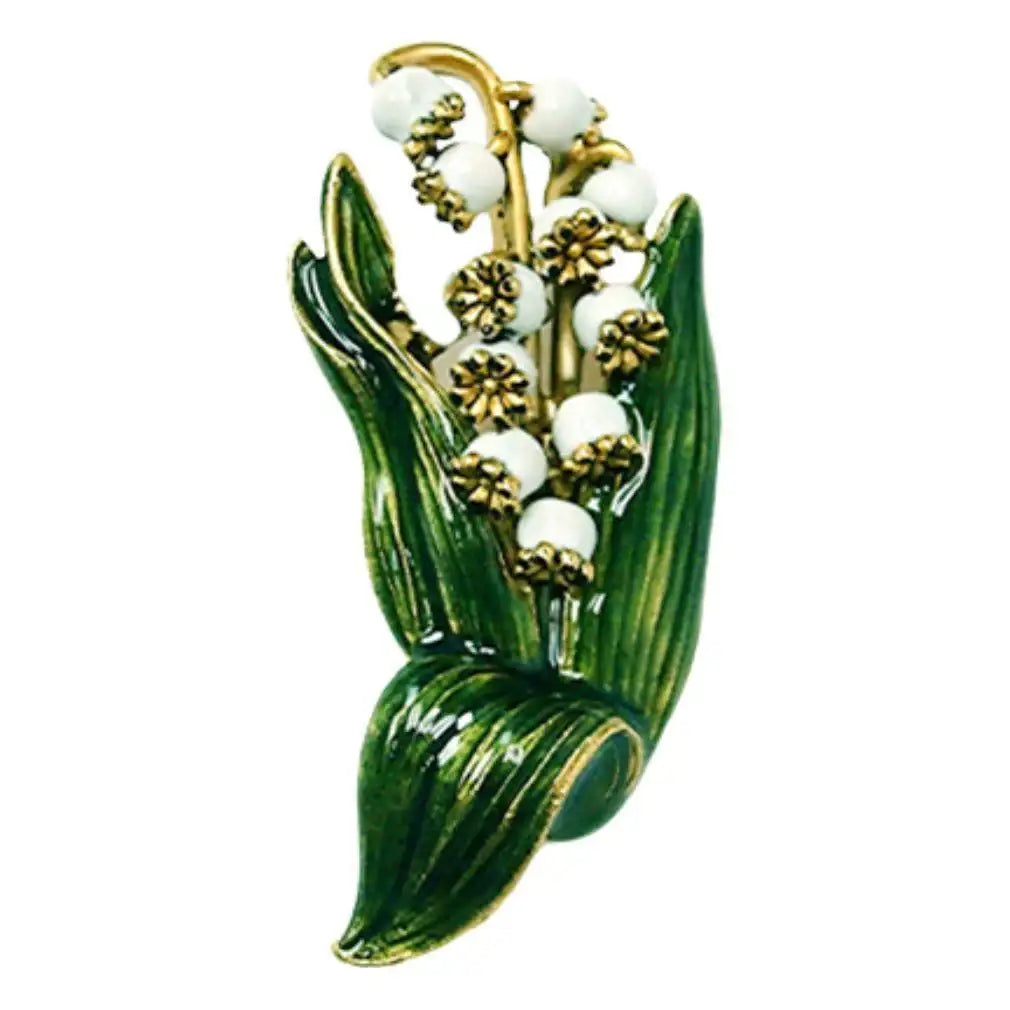
Faberge Lily of the Valley Pin Green White Enamel 2.2H
Faberge Lily of the Valley Pin Green White Enamel 2.2H
SKU:4036
In stock
Couldn't load pickup availability
A Royal Flower Basket Becomes the Faberge Lily Pin
White blossoms and green leaves, laid in enamel on a gold plated base. It is a quiet design. This Faberge lily pin copies a single flower from Carl Faberge's Lilies-of-the-Valley Basket of 1896.
The real basket is made of pearls, diamonds, gold and nephrite. It was a favorite possession of the last Tsarina. This lily of the valley brooch brings one stem down to lapel size.
Product Details
- Material: 24K gold plated pewter with color enamel details
- Dimensions: 1 in W x 2.2 in H
- Style: Enamel flower brooch, green and white
- Includes: Provenance card
- Note: Licensed reproduction. The original artwork is not included
- Origin: Made in USA
The Basket Behind the Lily of the Valley Brooch
Faberge used gold, pearls and diamonds, with leaves cut from green nephrite. The flowers rise from a gold basket. A modern viewer could mistake it for a living bouquet.
The Met calls it Faberge's floral masterpiece. It belongs to the Matilda Geddings Gray Foundation Collection. That collection was long shown at the New Orleans Museum of Art. The Metropolitan Museum has displayed it too.
A Flower That Means Something
Lily of the valley stood for happiness and marital bliss. It made a fitting gift for an empress. Alexandra Feodorovna loved the flower, and she loved pearls as well.
A lily of the valley brooch like this one is a spring token. The enamel is glossy. The gold plating adds warmth. The Faberge lily pin stands about 2.2 in tall.
Wearing Faberge Museum Jewelry
Pin the Faberge lily pin through a lapel, a wool scarf or a knit collar. Pewter is soft, so avoid thin silk. Wipe the enamel with a dry cloth after wearing.
Keep this enamel flower brooch away from perfume and water. Store it with its provenance card. Faberge museum jewelry is easy to damage and worth protecting. For more small works like this, browse our Museum Jewelry Pins and Brooches.
About Carl Faberge
Peter Carl Faberge took over his father's shop in Saint Petersburg in 1872. He grew it into the largest firm of its kind, with about 500 craftsmen. He left Russia after the 1917 revolution and died in Switzerland in 1920. Today an enamel flower brooch like this keeps one of his best ideas in miniature.
For More Reading from the Web
- See the real Lilies-of-the-Valley Basket behind the Faberge lily pin, beside three Imperial Easter eggs. Faberge from the Matilda Geddings Gray Foundation Collection - The Metropolitan Museum of Art
- Follow Faberge from a family workshop to the Russian court, with objects from the Royal Collection. Faberge museum jewelry begins here. Faberge: The Artist Jeweller - Royal Collection Trust