Greek Key Dining Table Base 29.5H
Greek Key Dining Table Base 29.5H
SKU:4633MW
Out of stock
Couldn't load pickup availability
A Greek Key Table Base With Classical Pattern
This Greek key table base is a plaster column with two classical motifs. A Greek meander band and a Roman strigil curve decorate its surface. The pictured finish is ochre with gray wash, a muted, softly aged tone. It stands 29.5 in tall under a glass top.
Product Details
- Material: Reinforced plaster (plaster with hemp), interior design quality
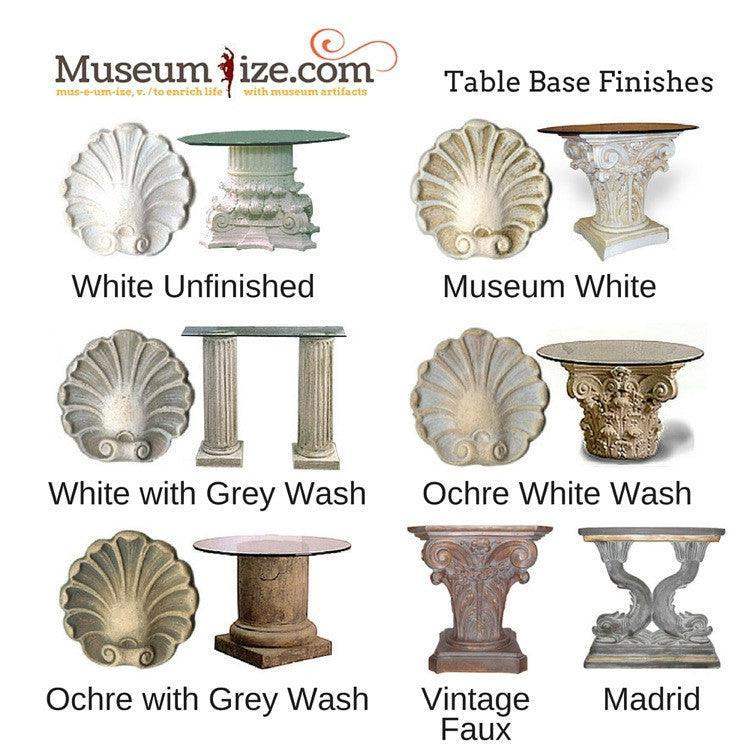
- Finish: Ochre with gray wash shown
- Dimensions: 29.5 in H x 20 in W x 20 in D
- Weight: 102 lbs
- Glass: Not included. One column takes a 48 to 54 in round top
- Glass for a pair: 42 x 84 in to 48 x 96 in, 1/2 to 3/4 in thick
- Shipping: Freight required, continental US only
- Product number: 4633
The Greek Key and the Meander
The Greek key is also called the meander, after a winding river in Asia Minor. Greek potters painted meander bands on cups and vases. A Met kylix fragment from the 5th century BC has meander ornament inside the cup. The pattern never ends, so it is often read as a sign of continuity. A meander pattern dining table brings that old idea indoors.
The Roman Strigil
A strigil was a curved metal scraper. Athletes used it to scrape oil and sweat from the skin after exercise. Its S-shape became a decorative motif on Roman sarcophagi. Combined with the Greek key, it makes a true Greco-Roman table base. Find related pieces in our Greek Roman Classical collection.
Using the Greek Key Table Base
Order glass locally, since none is included. One Greek key table base takes a 48 to 54 in round top. This column base for glass top tables weighs 102 lbs, so place it on a level floor. A meander pattern dining table looks best with clear glass. It also works as a Greco-Roman table base in a hall or study.
About Greek and Roman Ornament
Roman designers borrowed Greek ornament and reused it on temples, villas, and tombs. This quiet repetition gave architecture its rhythm. A Greek key table base carries that rhythm into a living room. It is also a handy column base for glass top tables.
For More Reading from the Web
- Want to spot the meander on an ancient cup? This Met entry describes a kylix fragment with meander ornament. Terracotta fragment of a kylix - The Metropolitan Museum of Art