Greek Men Attica Red Figure Vase Imported from Greece 11.2H
Greek Men Attica Red Figure Vase Imported from Greece 11.2H
SKU:B009
In stock
Couldn't load pickup availability
A Greek Athlete Vase from the Wrestling Ring
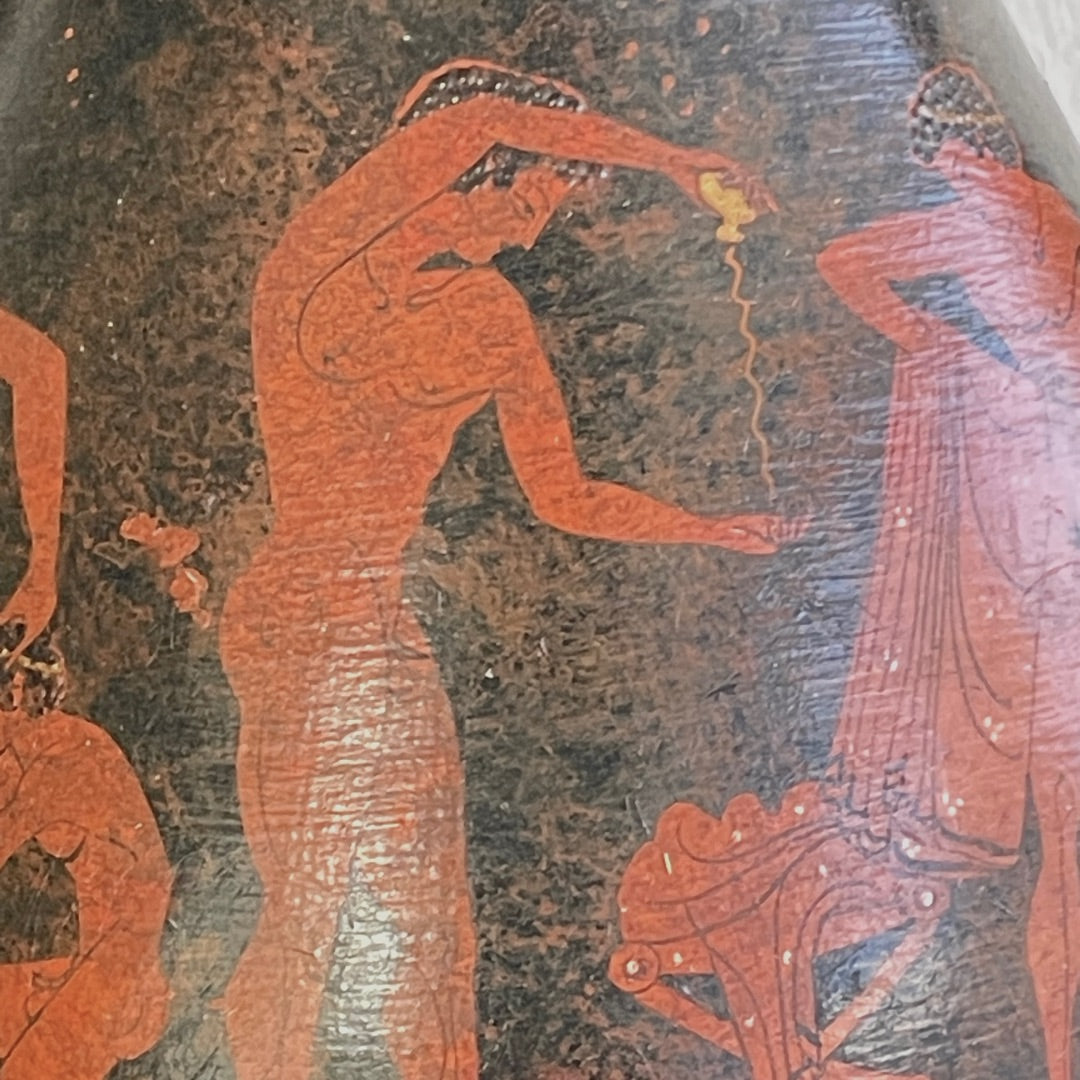
Wrestlers lock arms on one side of this vase, and men oil their skin on the other. This Greek athlete vase is a two-handled terracotta pelike from Greece. It stands 11.25 in tall. Orange-red figures stand on a black ground, with gold-yellow touches on headbands and a thread of oil. A metal seal from the Greek Ministry of Culture hangs from one handle.
**THE ITEM PICTURED IS THE ITEM YOU WILL RECEIVE / ONLY 1 AVAILABLE**
Product Details
- Material: Terracotta, hand spun on the wheel
- Origin: Made in Greece
- Certification: Greek Ministry pewter seal
- Dimensions: 11.25 in H x 7 in W x 7 in L
- Weight: 4.4 lbs
- Original pattern: about 460 BCE, copy signed by P. Vaglis
- Style: Attic red figure
- Status: No longer manufactured, and this vase is over 30 years old
- Product number: B009
Oil, Wrestling, and the Training Ground
On one side, a nude man raises an arm and pours a thread of oil from a flask. A boy kneels at the foot of a standing man in a draped cloak. A draped figure sits on a folding stool at the right.
The second side shows two pairs of wrestlers in holds. A folded cloth hangs between them, and a small jar stands on the ground. The scene could pass for a bath, but the wrestlers and oil flask point to the training ground. Ancient Greek athletes trained nude and rubbed olive oil on their skin to keep off dust. As a Greek wrestling vase, it shows a contest that belonged to the games.
A Pelike Made for Storage
A pelike is a two-handled storage jar with a pear-shaped body. This Greek pelike vase has a wide, flat rim and strap handles. The base label calls it a copy of an Attic amphora, a broad term for two-handled jars.
Red Figure and Patterned Bands
In red-figure painting, the figures keep the color of the clay and the painter fills the background with black. Fine brush lines draw the hair, muscles, and folds of cloth. A Greek key meander circles the body. A small panel of dotted squares breaks the band below each handle.
Copied from Museum Pattern Books
Workshops in Greece reproduce these vases after pattern books of pieces held in Greek museums. This copy is not one of a kind. It is very high quality and already over 30 years old. The base is marked as hand painted by P. Vaglis, after a pattern of about 460 BCE. Before export, the Greek Ministry of Culture applied the metal seal on the handle.
See more painted vessels in our Greek vase collection. You can also browse our Greek and Roman collection.
Display and Care
At 11.25 in tall and 4.4 lbs, this vase sits well on a shelf or table. Dust it with a dry, soft brush.
Athenian Red-Figure Workshops
Red-figure painting began in Athens in the late sixth century BCE. Athletes, trainers, and young men in training were a frequent subject.
For More Reading from the Web
- Find out why Greek athletes competed nude and covered in olive oil: Athletics in Ancient Greece - The Metropolitan Museum of Art
- See a pelike of the same shape, painted with young athletes in mid-jump: Pelike Depicting Young Athletes Jumping - Museum of Fine Arts, Boston
- Learn how Athenian painters made figures turn black or stay clay-colored in the kiln: Athenian Vase Painting: Black- and Red-Figure Techniques - The Metropolitan Museum of Art