


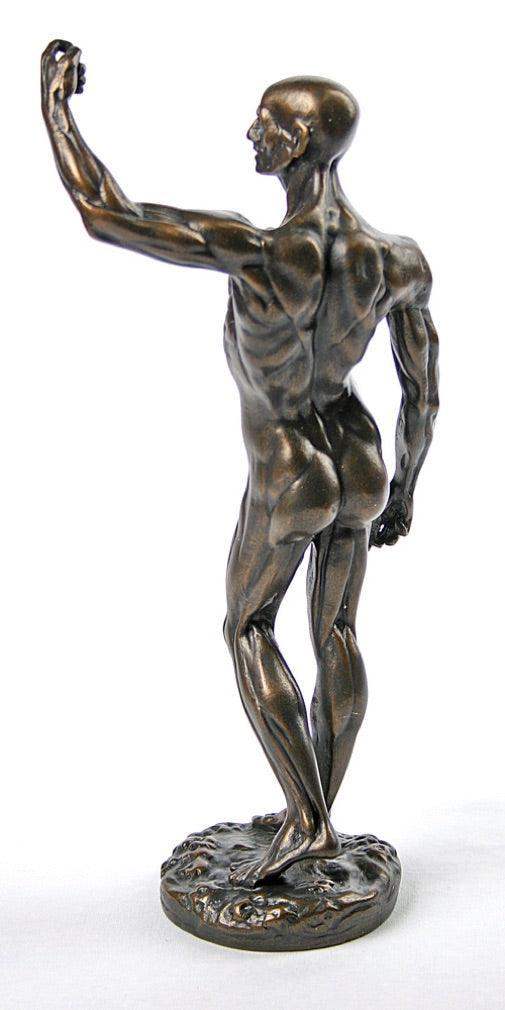
Anatomical Study of Flayed Male Man Anatomy L'ecorche Statue by Houdon 10H
Anatomical Study of Flayed Male Man Anatomy L'ecorche Statue by Houdon 10H
SKU:HOU01
In stock
Couldn't load pickup availability
Muscle Laid Bare: The Houdon Ecorche Statue
This Houdon Ecorche statue is the flayed man that taught Europe's artists how muscles work. It stands 10 in H x 4.5 in W x 2.75 in D in resin with a bronze finish.
Jean-Antoine Houdon modeled the original in Rome in 1767 as an anatomical study. This flayed man anatomy figure shows every muscle of the male body in detail.
Product Details
- Material: Resin with a bronze finish
- Dimensions: 10 in H x 4.5 in W x 2.75 in D
- Weight: 1 lb
- Collection: Parastone Museum Collection
- Original: L'Ecorche, Houdon's studio, late 18th century
- Product number: HOU01
A Teaching Tool That Became a Masterpiece
Houdon studied anatomy in Rome thanks to a surgeon. His Ecorche began as a study for a sculpture of Saint John the Baptist.
The French Academy in Rome asked for a plaster cast for teaching. By 1775 its rules required anatomy to be taught from his figure.
Plaster copies soon reached academies in Paris, Toulouse, Bordeaux, and Flanders. Every self-respecting academy in Europe wanted one.
Draw From It Yourself
An anatomical study statue still works as a drawing aid. Turn the Houdon Ecorche statue under a lamp and sketch the shadows on the muscles.
A male anatomy sculpture like this also suits a doctor's office or an artist's desk. See more in our Parastone Museum Replicas and Museum Statues Collection.
Display and Care
At 1 lb, the Houdon Ecorche statue sits easily on a desk or bookshelf. Dust it with a soft dry brush. Keep the bronze finish away from damp air.
Jean-Antoine Houdon in Brief
Houdon lived from 1741 to 1828. He won a scholarship to the French Academy in Rome in 1764. He later carved Voltaire and portraits of Washington and Jefferson, thanks to Benjamin Franklin.
For More Reading from the Web
- Read how the ecorche became the artist's best teaching aid in European academies. The Ecorche - Artists' Things, Getty
- Explore Houdon's other famous subject, George Washington, in the Mount Vernon collection. Jean-Antoine Houdon - Mount Vernon


FAQs
Got a question? We are here to answer