


Luba African Headrest | Congo Couple Statue for Wedding
Luba African Headrest | Congo Couple Statue for Wedding
SKU:AFR04
In stock
Couldn't load pickup availability
Luba Figural Headrest from the Democratic Republic of the Congo
The Luba people of south-central Democratic Republic of the Congo developed one of the most refined traditions of figural sculpture in Central Africa. Their kingdom, which began consolidating around the 16th century in the Katanga region, produced art in which personal objects — headrests, staffs, bowls — were elevated through skilled carving into works that carried social, spiritual, and political weight. The Luba African headrest was among the most intimate of these objects.
During sleep, it supported the neck and protected the elaborate hairstyle that signaled rank and identity. But its significance extended well beyond that function. A headrest reflected its owner's social standing, was believed to protect against nightmares, and was so closely tied to a person's identity that it was often buried with them when they died.
The artist who carved a headrest occupied a recognized position in Luba society. He was identified by the ceremonial axe he carried — a mark of his distinction — and was counted among a community of skilled specialists that included smiths, woodworkers, and potters. Luba artistic conventions were refined and widely respected: as the Luba empire expanded and neighboring chiefdoms were incorporated into its sphere, Luba sculptural forms traveled with it, spreading through what is now northern Angola, northwestern Zambia, and the southern DRC.
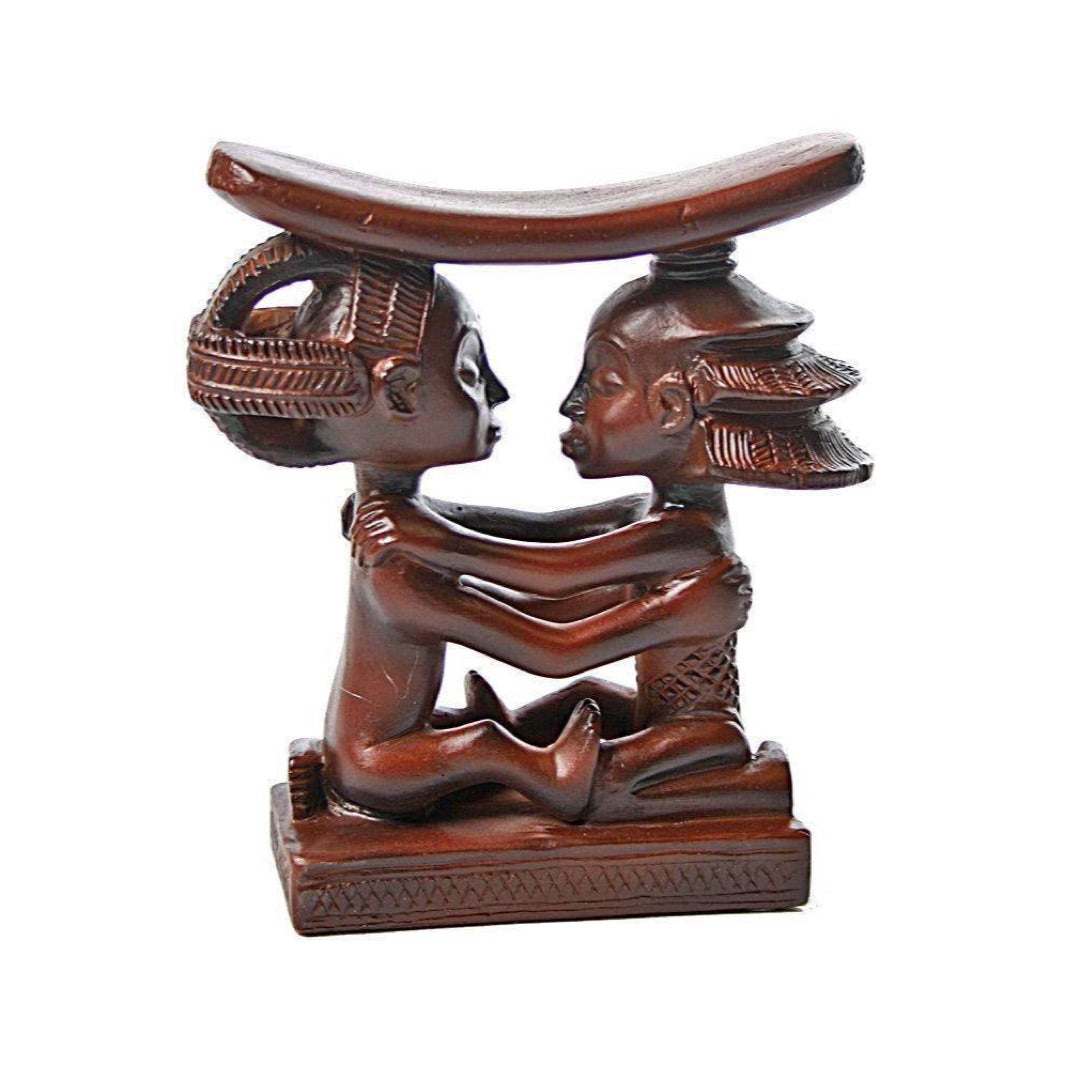
This particular Congo Luba sculpture depicts a man and a woman seated facing each other, their arms intertwined, both supporting the curved headrest platform above them. Each figure wears a distinct, elaborately carved hairstyle — one with a layered fan coiffure, the other with a basket-shaped headdress — markers of status in Luba visual culture. The embrace suggests a possible wedding context, since figural headrests depicting couples are, in Luba tradition, associated with union and partnership. The base features a geometric border in a carved-relief pattern consistent with Luba decorative practice.
As a depiction of two figures in embrace, this Luba African headrest replica connects naturally to works centered on love and partnership. See also Klimt's The Kiss, and browse the Romance, Love & Wedding Collection for related pieces that would pair well as wedding or anniversary gifts.
This African couple statue is part of the Parastone African Collection. It is cast in resin with a wood finish.
- Material: Resin with wood finish
- Size: 5.25 in H x 5 in W x 1.75 in D
- Weight: 1 lb
- Collection: Parastone African Collection
- Product Number: AFR04
Luba Headrest Tradition
Luba headrests were carved in a range of forms: some feature a single kneeling figure as the support; others, like this one, show two figures together. The figural support was not purely decorative — it connected the sleeping owner to ancestral presence and to the social world the figure represented. Museum collections worldwide hold 19th-century Luba headrests; the Metropolitan Museum of Art holds examples that illustrate the tradition's range and formal sophistication. The hairstyles carved into these figures were not arbitrary: specific coiffures marked lineage, status, and ceremonial roles, and a carver who rendered them accurately was demonstrating both technical skill and cultural knowledge.
Displaying Your Luba African Headrest Replica
The object is self-standing on its carved rectangular base. The front view — showing both figures face-to-face with the curved headrest above — is the most legible orientation, but the side view reveals the carving's depth and the profiles of the hairstyles. At 5 in W and 5.25 in H, it is compact enough for a shelf or cabinet but detailed enough to reward close attention. Dust gently with a soft, dry cloth. Avoid direct sunlight and harsh cleaners.
For More Reading


FAQs
Got a question? We are here to answer