


Greek Minoan Bees Necklace from Crete with Chain Necklace Gold Plate
Greek Minoan Bees Necklace from Crete with Chain Necklace Gold Plate
SKU:7265
In stock
Couldn't load pickup availability
A Bronze Age Treasure on a Chain: The Minoan Bee Necklace
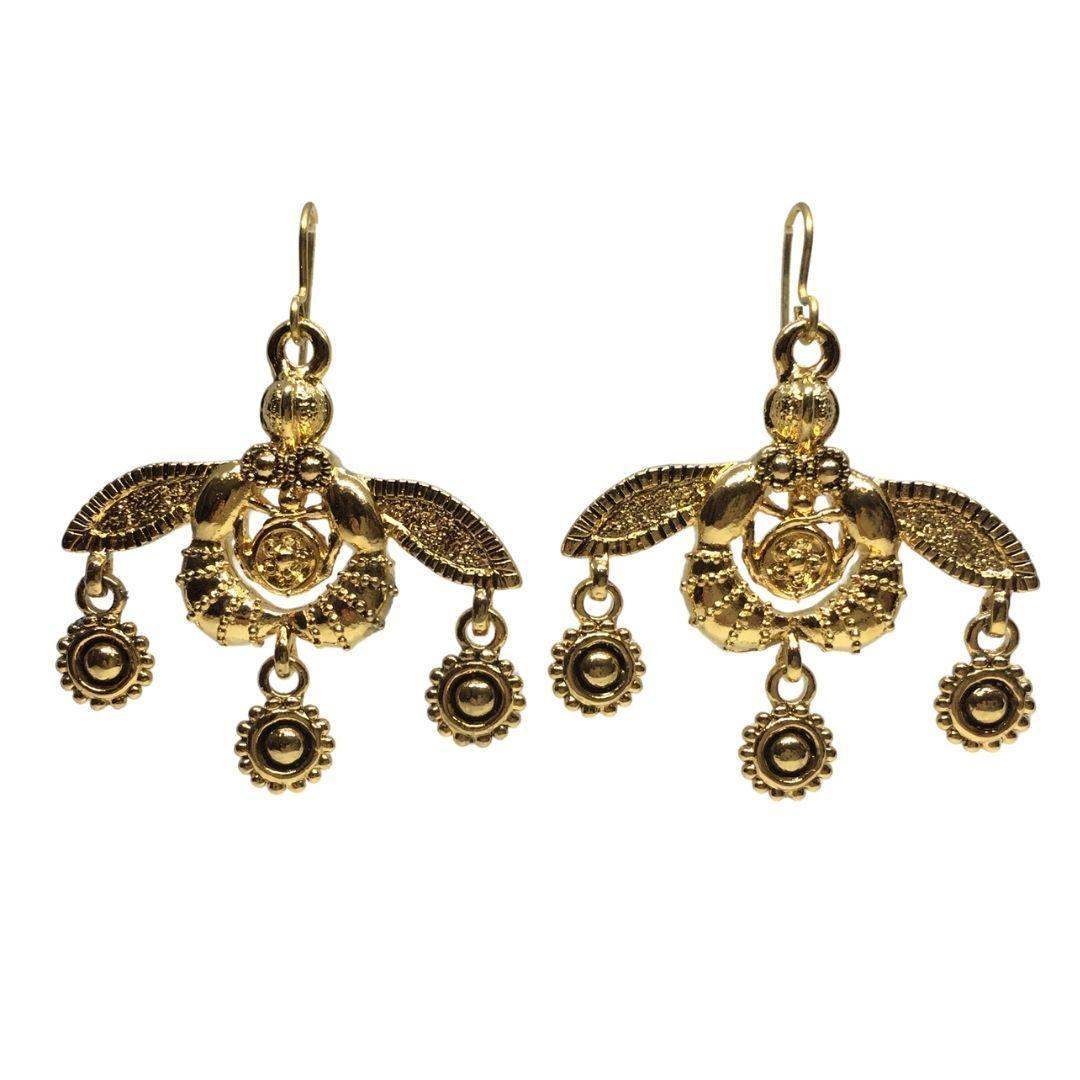
Two bees meet head to head, their wings spread behind them and small discs hanging beneath. This Minoan bee necklace is 1.5 in high and 1.5 in wide, on an 18 in chain.
The Greek bee pendant is thin at 1/8 in, so it lies flat against the chest.
Product Details
- Material: 24K gold plate over pewter
- Pendant: 1.5 in H x 1.5 in W x 1/8 in thick
- Chain: 18 in L, gold plate
- Product number: 7265
- Style: Malia bee pendant, Crete gold plate necklace
- Origin: Made in USA
From the Palace Cemetery at Malia
The Malia bee pendant comes from the Old Palace cemetery at Chrysolakkos. French archaeologists found it in 1930.
It is often called the most famous piece of Minoan jewelry. The original is in the Heraklion Archaeological Museum on Crete.
Bees and Their Meaning
The goldsmith placed the two insects in mirror image. They hold a central disc between their legs, which many see as a honeycomb.
Honey was important to Minoan offerings and trade. Bees stood for regeneration. A Greek bee pendant therefore speaks of renewal.
Wearing and Display
Wear the Minoan bee necklace at the collarbone on its 18 in chain. Wipe with a soft cloth and store flat.
A Crete gold plate necklace looks best on a plain top. See more in our Museum Jewelry Necklaces.
About Minoan Gold
Minoan goldsmiths worked with fine wire and tiny beads nearly 3,800 years ago. The Minoan bee necklace is a modern echo of that skill. The pendant remains one of the great Bronze Age designs. The Greek bee pendant reaches back before classical Greece.
For More Reading from the Web
- See the original pendant described in detail, with the debate over bees or wasps. The Malia bee pendant is still studied today. Malia Pendant - Wikipedia


FAQs
Got a question? We are here to answer