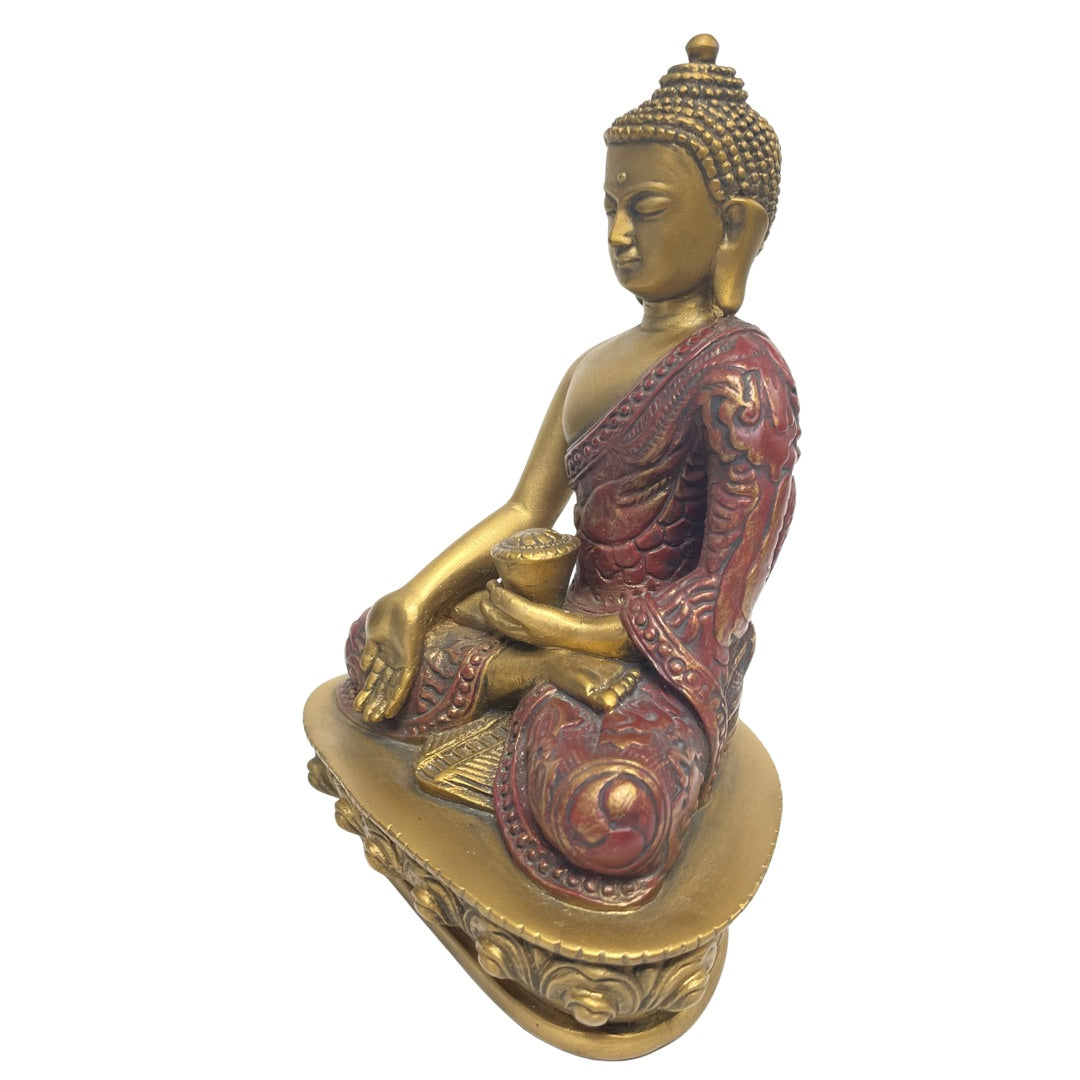
Nepali Style Buddha in Wish Giving Pose, Desktop Statue, Antique Gold and Red, 5.75 in
Nepali Style Buddha in Wish Giving Pose, Desktop Statue, Antique Gold and Red, 5.75 in
SKU:O-090GR
In stock
Couldn't load pickup availability
Generosity in a Gesture: a Nepali Buddha Statue
This Buddha shows the wish giving mudra. One hand points down with the palm facing forward. The Nepali Buddha statue belongs to a series of similar sized figures, each in a different pose. Fine details and an antique gold and red finish give it a quiet, devotional look.
Product Details
- Material: Crushed stone and resin
- Finish: Antique gold and red
- Dimensions: 5.75 in H x 4 in W x 2.5 in D
- Weight: 0.7 lbs
- Product number: O-090GR
Reading the Gesture
The wish giving mudra is a lowered hand with the palm turned outward. Buddhist art calls it the Buddhist varada mudra, meaning a wish-granting or boon-granting gesture. The arm hangs down and the fingers point toward the ground. It appears often on images of Amitabha. A mudra is a hand gesture with a set meaning, so viewers can read a figure without a caption.
Nepali Style Buddha Art
Nepali style Buddha images come from the Kathmandu Valley, where Newar artists worked for centuries. The Metropolitan Museum notes that Buddhism and Hinduism live side by side in Nepal. Artists there drew on Gupta and Pala styles from India and often worked in gilded copper. A Nepali style Buddha in resin carries a trace of that tradition.
An Older Parallel
The Metropolitan Museum owns a Nepalese Padmapani of the 11th to 12th century, shown in the Buddhist varada mudra. He offers boons to those who come to him. This Nepali Buddha statue is a modern piece, but the wish giving mudra is old.
Using the Statue
A Nepali Buddha figurine works well on a desk, a shelf, or a home altar. Its lowered hand invites a gentle, open mood. Because the figure is part of a series, you can add other mudras over time. The Buddhist varada mudra here makes a good first choice for anyone who values generosity. This Nepali Buddha statue is light at 0.7 lbs and easy to move.
At 5.75 in tall and 0.7 lbs, this Nepali Buddha statue suits a desk or a small altar. It belongs to a series of similar sized figures, so you can build a set. Dust it with a soft cloth. See more of our Asian Art Collection, including the Vajradhara figurine.
Siddhartha Gautama, the Buddha, was born into the Sakya clan. Tradition places his birth at Lumbini, in present day Nepal. It dates the birth to about 563 BC, though scholars debate the dates. He left palace life after meeting suffering in the world and taught a path to awakening. The wish giving mudra recalls the compassion at the center of that teaching.
For More Reading
- Learn what the lowered hand and open palm mean. Varada Mudra - Chung Tai World Museum
- See a Nepalese Padmapani offering boons. Padmapani - The Metropolitan Museum of Art
- Read how Newar artists shaped Nepalese sculpture. Nepalese Sculpture - The Metropolitan Museum of Art
- Read more on hand gestures in Indian religion. Mudra - Wikipedia