Nike and Horseman Greek Red Figure Oinochoe Vase Imported from Greece 13H
Nike and Horseman Greek Red Figure Oinochoe Vase Imported from Greece 13H
SKU:B001
In stock
Couldn't load pickup availability
A Greek Horse Vase Where Victory Takes Wing
A young rider fills one side of this vase, and winged women fill the other. This Greek horse vase is a hand spun terracotta oinochoe, or wine jug, from Greece. It stands 13 in tall. Orange figures stand on a black ground. Gold-yellow touches mark the headbands and bracelets. A single strap handle rises to a flared rim, and a metal seal hangs from it.
**THE ITEM PICTURED IS THE ITEM YOU WILL RECEIVE / ONLY 1 AVAILABLE**
Product Details
- Material: Terracotta, hand spun on the wheel
- Origin: Made in Greece
- Certification: Greek Ministry pewter seal
- Dimensions: 13 in H x 7.5 in W x 7.5 in L
- Weight: 6.5 lbs
- Original pattern: about 460 BCE, copy signed by P. Vaglis
- Style: Attic red figure
- Status: No longer manufactured, and this vase is over 30 years old
- Product number: B001
A Rider, a Small Horse, and Painted Jars
On one side, a nude youth rides bareback. He holds the reins low in one hand. A gold band circles his dotted curls. The horse wears a bridle and a breast strap marked with dots. A smaller horse runs below. Painted jars fill the space around them.
Horses were a sign of wealth in Athens. Few families could afford to keep one. In 431 BCE the city fielded only 1,000 cavalrymen. A rider on a vase could suggest that status. As a Greek horseman vase, this oinochoe pictures a young man at ease with his mount.
Two Winged Figures Beside a Column
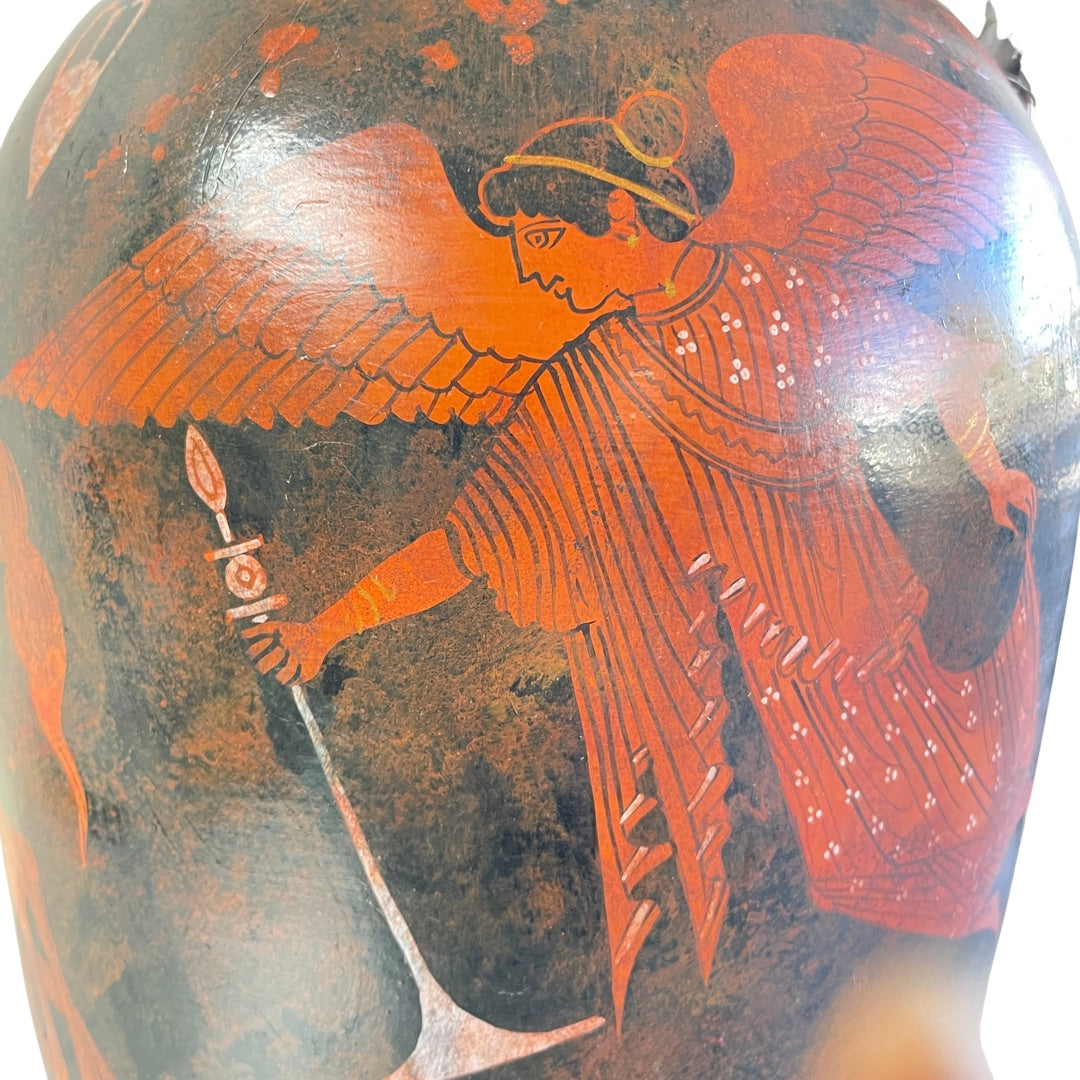
The other side shows two winged women flanking an Ionic column. Ribbons or cloth hang from its capital. One carries a round jar in both hands. The other leans down and holds a long staff with a leaf-shaped tip. White dots pattern their long robes.
These are Nikai, the plural of Nike, the winged goddess of victory. The Greek Ministry of Culture notes that Attic vases show Nike carrying prizes or watching races. The painter names no contest here. The jar in her hands may allude to a prize, but the scene stays general. As a Nike Greek vase, it reads as a toast to winning.
A Wine Jug in Red Figure
An oinochoe is a wine jug. Servers dipped it into a large mixing bowl and poured wine into cups. It was made for the table. In red-figure painting, the figures keep the color of the clay and the painter fills the background with black. Fine brush lines draw the hair, wings, and folds of cloth. A band of tongues circles the neck. A Greek key meander with cross panels circles the shoulder. Upright leaf shapes ring the base.
Copied from Museum Pattern Books
This Greek red figure jug is a hand painted copy. The base marks it as hand painted by P. Vaglis, after an Attic oinochoe of 460 BCE. Workshops in Greece reproduce these vases after pattern books of pieces held in Greek museums. This copy is not one of a kind. It is very high quality and over 30 years old. Before export, the Greek Ministry of Culture applied the metal seal on the handle.
See more painted vessels in our Greek vase collection. You can also browse our Greek and Roman collection.
Display and Care
At 13 in tall and 6.5 lbs, this Greek horse vase sits well on a shelf, mantel, or table. Keep it away from edges. Dust it with a dry, soft brush.
Athenian Red-Figure Workshops
Red-figure painting began in Athens in the late sixth century BCE. Painters could now draw inner detail with a brush instead of a cutting tool. That freedom suits wings, drapery, and the curls of a Nike Greek vase like this one. It also suits the manes and tack on a Greek horseman vase.
For More Reading from the Web
- See how Nike carries prizes and pours offerings on Attic wine jugs: Red Figured Oinochoe with Nike at an Altar - Hellenic Ministry of Culture
- Find out why only wealthy Greeks kept horses, and how many Athens sent to war: Horses in Ancient Greek Life - University of Colorado Boulder
- Learn how Athenian painters made figures turn black or stay clay-colored in the kiln: Athenian Vase Painting: Black- and Red-Figure Techniques - The Metropolitan Museum of Art