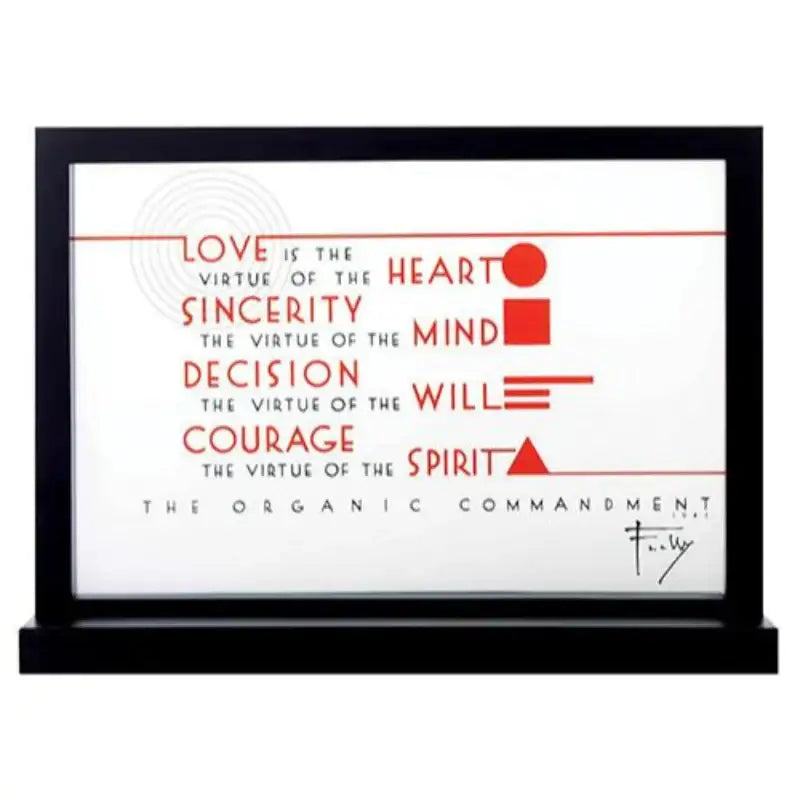
Organic Commandment Stained Glass by Frank Lloyd Wright 11.25L
Organic Commandment Stained Glass by Frank Lloyd Wright 11.25L
SKU:T83370
In stock
Couldn't load pickup availability
Organic Commandment Stained Glass: Four Virtues in Glass
Frank Lloyd Wright set down his philosophy of organic living in a famous statement of 1940. This Organic Commandment stained glass panel reproduces his poster design. It is meant to stand near your own center of inspiration.
The Frank Lloyd Wright Organic Commandment pairs four virtues with four human faculties. Love belongs to the heart, sincerity to the mind, decision to the will, and courage to the spirit.
By 1940 Wright had completed Fallingwater and begun Taliesin West. The statement shows that organic ideas guided his life as well as his buildings.
Wright's Organic Philosophy in Words
Organic architecture, as Wright taught it, grows from nature and from human need. This Frank Lloyd Wright poster design extends that idea to conduct. Frank Lloyd Wright art glass seldom speaks so directly in words. Organic Commandment stained glass keeps that message in view.
Wright called his glass designs light screens. See related pieces in our Frank Lloyd Wright stained glass collection. A Frank Lloyd Wright poster design in glass lets the message glow when light passes through. The Frank Lloyd Wright Organic Commandment is meant for a place of work or thought.
Product Details
- Design: The Organic Commandment, 1940
- Artist: Frank Lloyd Wright (1867-1959)
- Material: Kiln-fired glass
- Frame: Wood frame and base
- Size: 11.25 in L x 7.75 in W x 0.13 in thick
- Authorization: Licensed from the Frank Lloyd Wright Foundation
Display Notes
Set the panel on its wood base at a desk or shelf, near a window or lamp. Frank Lloyd Wright art glass shows its colors best when light passes through the Organic Commandment stained glass.
Frank Lloyd Wright in Brief
Frank Lloyd Wright (1867-1959) was born in Wisconsin and trained under Louis Sullivan in Chicago. In his Oak Park studio he developed the Prairie style, with low horizontal lines and open interiors. He designed buildings as whole environments, down to the furniture, textiles, and art glass. He created well over 4,000 leaded glass windows and doors, which he called light screens. His later work includes Fallingwater and the Guggenheim Museum, and his influence reaches far beyond architecture.
For More Reading