


Centaur and Lapith Metope from Greek Parthenon Frieze Wall Hanging 16H
Centaur and Lapith Metope from Greek Parthenon Frieze Wall Hanging 16H
SKU:T87990
In stock
Couldn't load pickup availability
When Wedding Guests Became Warriors: A Parthenon Metope Wall Hanging
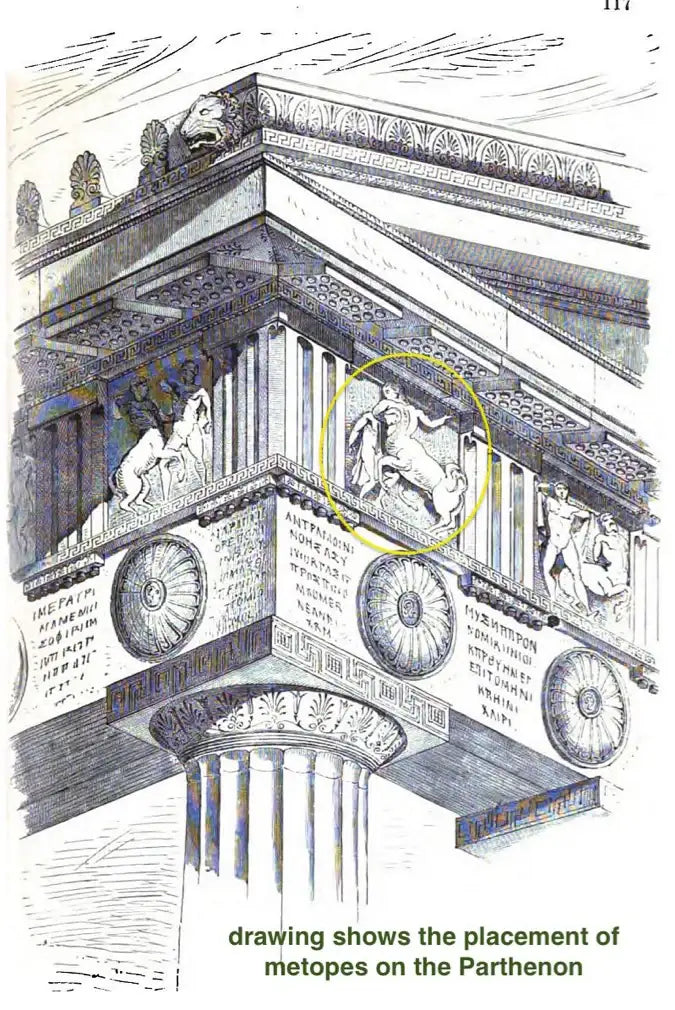
A centaur and a Greek warrior grapple in a square of stone. This Parthenon metope wall hanging reproduces one of the 92 panels that ringed the Parthenon in Athens. It is made to look like an ancient fragment.
The panels show the battle of the Centaurs and Lapiths. In Greek myth, centaurs were invited to a wedding feast. They grew drunk, and a brawl broke out. Greeks read the story as civilization against wild excess.
Each Parthenon metope was carved in high relief, so figures seem to leap from the block. This Greek Parthenon replica keeps that depth. The aged patina suggests a weathered fragment. A Parthenon metope wall hanging like this teaches ancient myth at a glance.
High Relief and Heroic Tension
The sculptors set body against body in a tight square. Muscles strain, and drapery flies. A Centaur and Lapith relief is a lesson in controlled drama. This Greek Parthenon replica brings that control into your home.
The resin has an aged patina, so it looks excavated rather than new. See more ancient art in our Greek and Roman collection. This ancient Greek wall plaque suits a study, library, or stair hall. Any Centaur and Lapith relief rewards raking light.
Product Details
- Design source: Centaur and Lapith metope, Parthenon, Athens
- Material: Resin with aged patina
- Size: 16 in H x 15.75 in W x 4 in D
- Weight: Approx. 15 lbs
- Mounting: Ready to hang
- SKU / PN: T87990
Display Notes
At about 15 lbs, the panel needs a sturdy wall fixing. This Parthenon metope wall hanging looks best in raking side light. Keep it indoors and dust it with a soft brush. A Greek Parthenon replica of this size needs space around it. Every Parthenon metope wall hanging should hang at eye level.
The Parthenon Sculptures
The Parthenon rose on the Athenian Acropolis between 447 and 432 BC, under the direction of the sculptor Pheidias. Its sculpture had three parts. These were 92 carved metopes, a long frieze, and pediment figures. Most of the surviving pieces are now divided between Athens, London, and Paris. Together they form the finest record of Classical Greek relief carving.
For More Reading

FAQs
Got a question? We are here to answer