


Red Ochre Dawn of Creativity - Paleolithic Pigment on Display Card
Red Ochre Dawn of Creativity - Paleolithic Pigment on Display Card
SKU:80-112-0458-201-40
In stock
Couldn't load pickup availability
A Red Ochre Specimen: The Pigment Behind Humanity's First Art
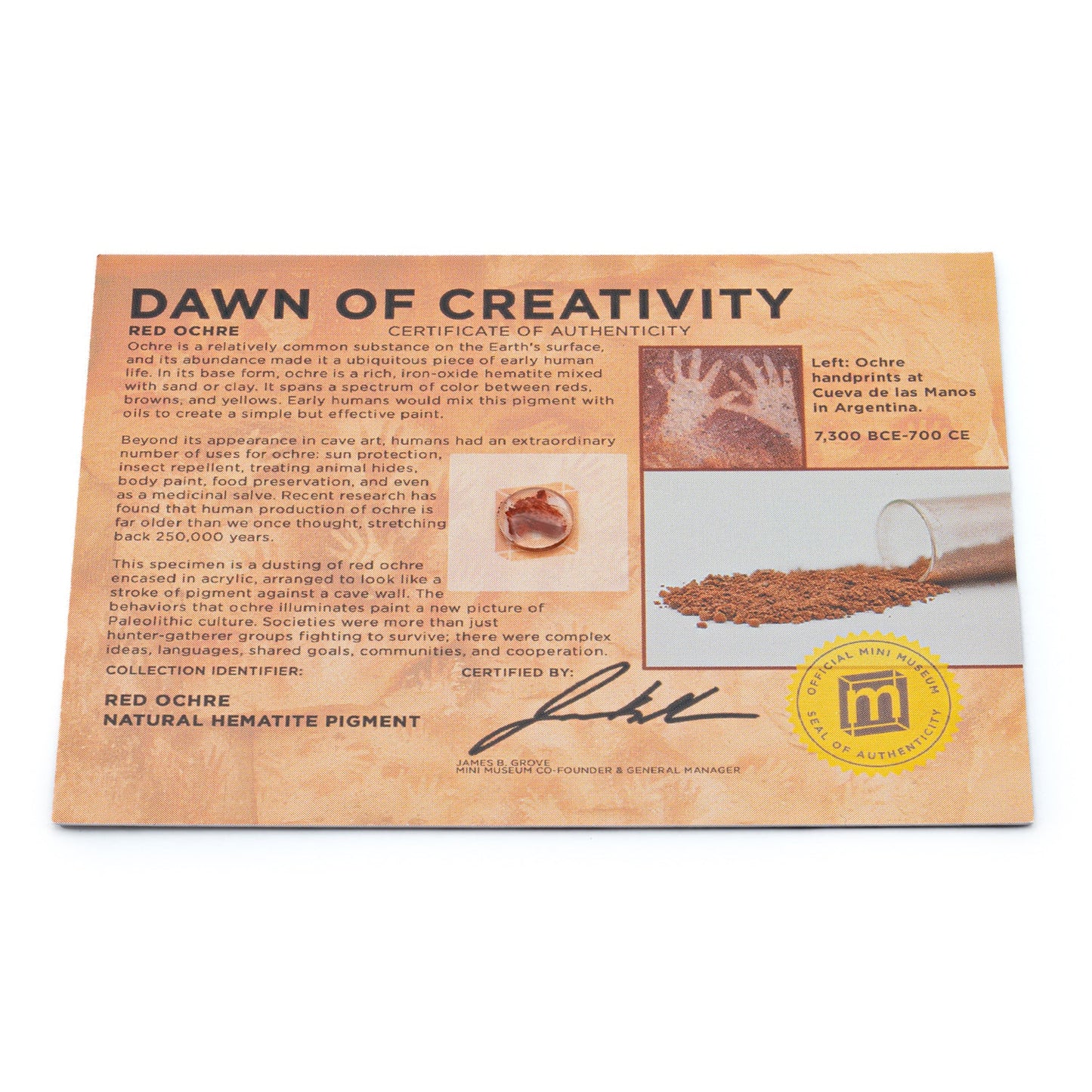
This red ochre specimen is a sample of the pigment early humans used to paint cave walls. It is mounted on a 4 in x 3 in card that explains ochre in the Paleolithic world.
Product Details
- Specimen: Red ochre, a natural iron oxide pigment
- Mounting: Arranged to resemble a brushstroke on a cave wall
- Display: 4 in x 3 in card with photos and information about red ochre
- Includes: Certificate of authenticity on the card
- Edition: First appeared in the Mini Museum Fifth Edition
What Is Ochre?
Raw ochre is mainly hematite mixed with sand or clay. Hematite is an iron oxide pigment with a red color. Ochre ranges from red to brown to yellow, depending on the region.
Ochre pigment turns up at Paleolithic sites in Australia, Africa, Europe, the Americas and the Mediterranean.
Ochre and the First Art
Ochre made some of the earliest known Paleolithic cave art. The Cueva de las Manos in Argentina holds famous ochre handprint stencils. Recent research dates human ochre use back about 250,000 years.
At Blombos Cave in South Africa, a workshop about 100,000 years old held ground ochre, charcoal and abalone shells. Smithsonian Magazine calls it the earliest known artist's studio. See more early human pieces in our Prehistoric Collection and our Natural History Collection.
Display and Care
Keep the card out of direct sun and damp. The ochre pigment on this card is a natural material, so handle the card by its edges.
About Ochre in Daily Life
People also used ochre for sun protection, insect repellent, treating hides, body paint and medicine. A roughly 70,000-year-old adhesive contained ochre, which suggests early multistep recipes. Paleolithic cave art began with preparing pigments like this one. Your red ochre specimen is a small piece of that long history.
For More Reading from the Web
- Step inside the workshop where ochre was ground and mixed. The Earliest Known Artist's Studio - Smithsonian Magazine


FAQs
Got a question? We are here to answer