


Roman Republic Coin Replica Set – Julius Caesar, Brutus & Mark Antony Denarius Reproductions
Roman Republic Coin Replica Set – Julius Caesar, Brutus & Mark Antony Denarius Reproductions
SKU:WR-1006
In stock
Couldn't load pickup availability
Roman Denarius Replica Set: Three Coins, One Turning Point in Rome
This Roman Denarius Replica Set brings together three coins minted during the last years of the Roman Republic. Julius Caesar struck the first. His assassin, Marcus Brutus, struck the second. His former ally, Mark Antony, struck the third. Together, the coins trace the decade between Caesar's rise and the fall of the Republic he reshaped.
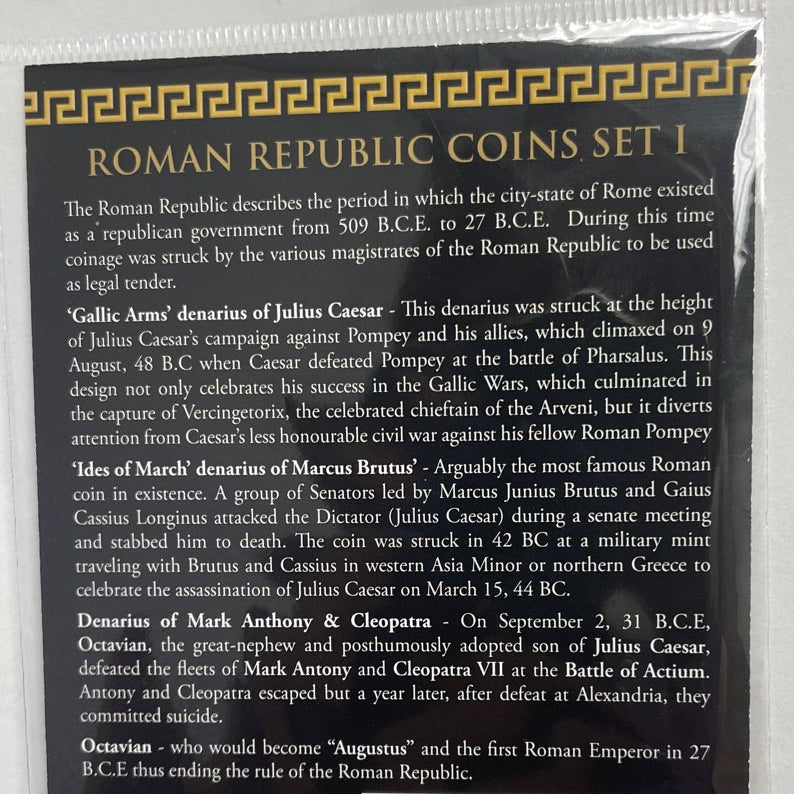
Every coin in this Roman Denarius Replica Set reproduces the obverse and reverse of its original denarius. Each is cast in lead-free pewter. It arrives on an illustrated card that explains what the coin meant to the person who ordered it struck.
Item details:
- Material: lead-free pewter
- Coin diameter: approximately 0.75 in each
- Included: 3 double-sided coin reproductions on an illustrated history card
- Product number: WR-1006
- Collection: Greek and Roman Collection
The Gallic Arms Denarius of Julius Caesar
This Julius Caesar coin replica shows the head of Venus on one side. Caesar claimed Venus as his ancestor. The other side carries a trophy of captured Gallic armor: a horned helmet, shield, and carnyx war horn. Caesar struck the original around 48 to 47 BCE while fighting Pompey for control of Rome. It reminded his legions of the victory that had made him famous. That victory was the defeat of the Arverni chieftain Vercingetorix in Gaul.
The Ides of March Denarius of Marcus Brutus
Marcus Brutus, one of Caesar's assassins, had this denarius struck in 42 BCE. The mint traveled with his army through Greece. The obverse shows Brutus himself. The reverse shows a pileus, the cap given to freed Roman slaves. Two daggers flank the cap, representing the weapons used against Caesar. Above them are the words EID MAR, short for Eidibus Martiis, on the Ides of March. Collectors and historians call this the Ides of March coin. Around 100 silver examples are known to survive today.
The Legionary Denarius of Mark Antony
Mark Antony struck this coin in 32 to 31 BCE to pay his soldiers before the Battle of Actium. One side shows a war galley. The other shows a legionary eagle flanked by two military standards, marking which legion the coin paid. Antony minted an estimated 25 to 35 million of these coins, more than any other issue of the Republic. He lost at Actium that September, and within a year Octavian stood as Rome's first emperor, Augustus.
Collecting the Set
These three coins are often collected together. They mark cause and consequence: Caesar's military triumph, his assassination, and the war that followed it. Each ancient Roman coin replica in the set reproduces a different moment in the same story. Many customers display them in order, alongside a short timeline.
Displaying the Set
The backer card stands on its own on a shelf or desk. You can also remove the coins and mount them in a small display case or shadow box. Pewter does not tarnish the way silver does, so the coins need no polishing. Keep the card out of direct sunlight so the printed text does not fade.
For More Reading
NGC Ancients: Julius Caesar and His Coinage
The Fitzwilliam Museum: Denarius of Brutus
Encyclopaedia Romana: The Legionary Denarius of Mark Antony


FAQs
Got a question? We are here to answer