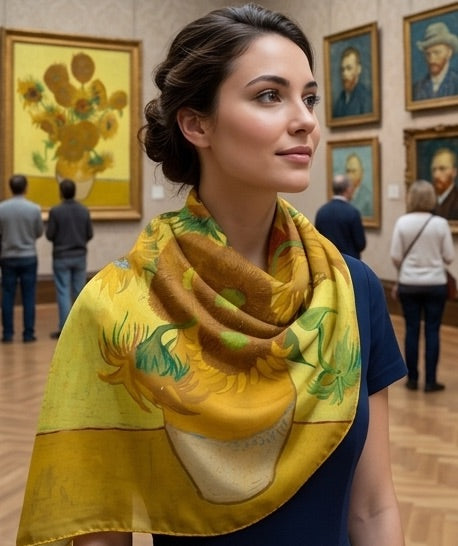
Scarf - Van Gogh Sunflowers Faux Silk Square, 35.5 in
Scarf - Van Gogh Sunflowers Faux Silk Square, 35.5 in
SKU:EV1024
In stock
Couldn't load pickup availability
Golden and Radiant | The Most Recognized Bouquet in Art History
Few images in Western art are as instantly recognizable -- or as purely joyful -- as Van Gogh's Sunflowers. Painted in Arles in the summer of 1888, the series was created to decorate the Yellow House, where Van Gogh hoped to establish an artists' community with Paul Gauguin. Fifteen sunflowers crowd a ceramic vase against a warm yellow ground, their faces turned at every angle, some blooming, some browning, all of them radiant with the particular golden light of Provence in summer. It is a painting that seems to generate warmth.
This Van Gogh Sunflowers faux silk square scarf translates that warmth directly into something wearable. Made from satin polyester faux silk, the 35.5 x 35.5 inch square scarf is an all-over wash of golden yellows, warm ambers, and earthy ochres with green accents -- a palette that flatters almost any wardrobe and lifts any mood. The satin finish makes the colors glow; the stitched edges give a polished, finished look. Wear it as a neck scarf, wrap it around your head, or tie it to a bag. It also pairs beautifully with selections from our Museum Tote Bag Collection.
One of the most beloved museum gift ideas for art lovers, a cheerful birthday gift, a thank-you with real warmth behind it. Pure, concentrated sunshine, worn and remembered.
- Material: Satin polyester faux silk
- Size: 35.5 x 35.5 inches (90 x 90 cm)
- Printed one side | Stitched edges | Satin finish | Vibrant colors
Vincent van Gogh | Master of Post-Impressionism
Vincent van Gogh (1853-1890) worked with ferocious creative energy, producing nearly 900 paintings in just over a decade. Self-taught for much of his early career, he absorbed the lessons of the Impressionists during his time in Paris, then surpassed them, developing a personal style of such intensity and originality that it would directly influence Expressionism, Fauvism, and virtually every major movement of 20th-century art.
As a Post-Impressionist, Van Gogh was not interested in painting the world as it appeared; he was interested in painting how it felt. His brushwork, laid on in thick, directional strokes of pure color, gives his surfaces an almost physical energy. His Sunflowers series is among the most studied examples of this approach: the yellow-on-yellow composition, which academic painting would have considered tonally reckless, vibrates with an inner light that photography struggles to capture. The series is now distributed across museums in London, Amsterdam, Munich, Philadelphia, and Tokyo, a testament to the extent to which Van Gogh transformed the humble bouquet into something transcendent.