


Torso of a Cuirassed Statue - Reproduction
Torso of a Cuirassed Statue - Reproduction
SKU:MRTORSO
Couldn't load pickup availability
Cuirassed Torso: A Roman General in Stone
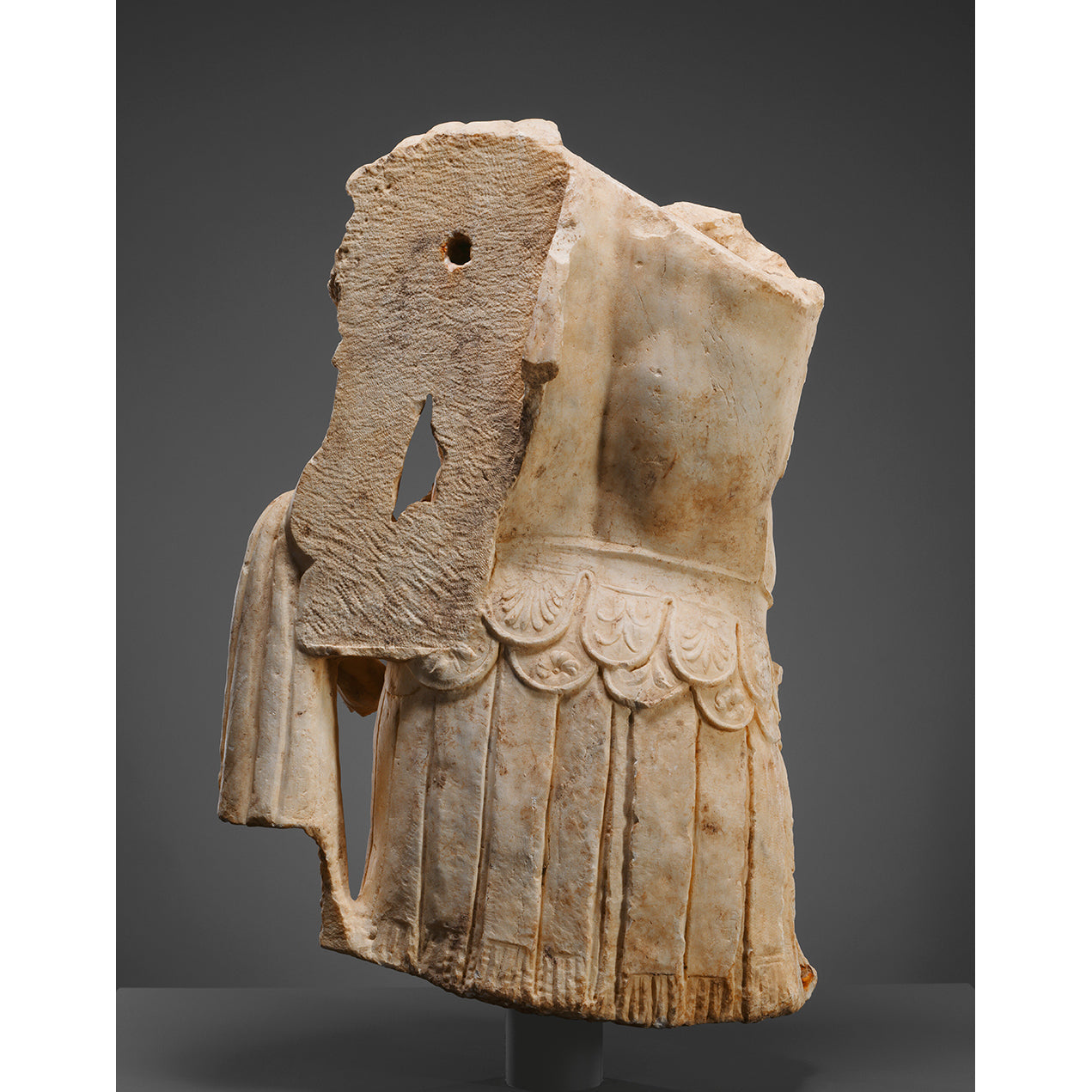
This cuirassed torso shows a Roman officer's armored chest in bonded marble with a faux finish. The breastplate molds the muscles of the body. Decorated tabs hang at its lower edge. It is a compact Roman military statue for a desk or shelf.
Only the torso and one arm survive from the over life-size original. It is in the Getty Museum, object number 71.AA.436. It dates to about CE 81-96. This Getty torso reproduction keeps the pose and the carved armor.
Product Details
- Material: Bonded marble with faux finish
- Size: 7 1/2 in L x 4 in W x 4 in H
- Gift box included
- Item number: MRTORSO
Reading the Armor
Cuirassed statues were a popular form of sculpture. They honored emperors, their male relatives, victorious generals and military heroes. On most, the breastplate carries rich relief decoration that stresses the emperor's power.
This cuirassed torso is unusual. Its breastplate is a plain rendition of human muscles, with no ornament. That lack of decoration probably means the statue did not show the emperor or his family. It more likely honored a general.
Every cuirassed torso deserves a good look under bright, even light. Guests tend to ask about the cuirassed torso first. Handle the cuirassed torso gently and it will last for years. Take time to study the cuirassed torso from every angle.
The Eagle and the Hare
The tabs at the bottom are called pteryges, and these are decorated. Motifs include palmettes, rosettes and gorgon heads. You will also find lion, lynx and ram heads. Most significant is an eagle clutching the underbelly of a hare.
That hare motif, plus the pose and the style of carving, dates the statue to the Flavian dynasty. It belongs to the early rule of the emperor Domitian. Collectors of Domitian era sculpture prize such details.
A famous bronze of Germanicus shows how tabs could be decorated. Its upper row alternates lion and satyr heads, and its lower row carries palmettes.
Source Object
Title: Torso of a Cuirassed Statue. Culture: Roman. Place: Italy (place created). Date: about CE 81-96. Medium: Marble. Object number: 71.AA.436. Dimensions: 107.5 x 78.7 x 34.3 cm (42 5/16 x 31 x 13 1/2 in).
Displaying the Torso
Set this Roman military statue on a desk, a shelf or a library table. Light from the side brings out the muscles and the carved tabs. Dust it with a soft, dry cloth.
For anyone drawn to Roman military statue, this piece offers a closer look. This piece belongs with Roman military statue that you may already own or admire. This piece belongs with Domitian era sculpture that you may already own or admire. Curators often say that Domitian era sculpture rewards slow looking. Here, Domitian era sculpture becomes something you can hold or display.
Curators often say that Getty torso reproduction rewards slow looking. Here, Getty torso reproduction becomes something you can hold or display. Readers interested in Getty torso reproduction will find the notes here a helpful guide. Think of it as Getty torso reproduction meant for daily enjoyment.
More classical figures are in our Greek and Roman collection.
The Flavian Dynasty
The Flavian dynasty ruled Rome from CE 69 to 96. Its emperors were Vespasian, Titus and Domitian. Domitian reigned from CE 81 to 96, which matches the date of this torso. Portrait statues of the age mixed military dress with the idea of divine power.
For More Reading from the Web
- See how a bronze Roman commander wears the same type of armor, tabs and all. Statue of Germanicus (Amelia) - Wikipedia


FAQs
Got a question? We are here to answer