


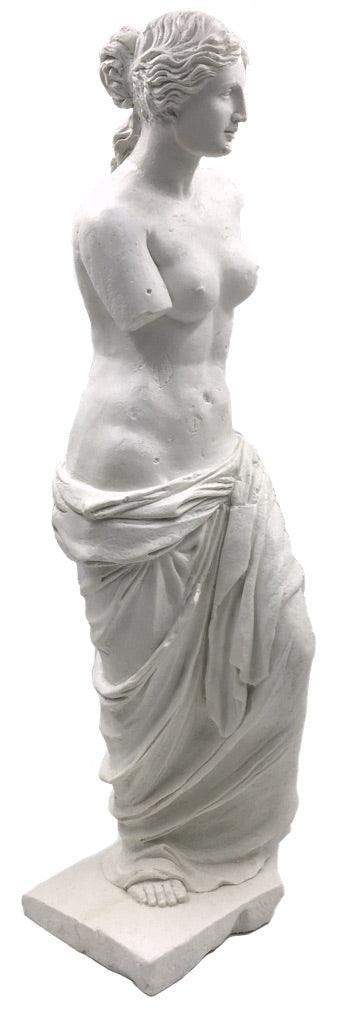
Aphrodite of Melos Venus de Milo Greek Statue 17H
Aphrodite of Melos Venus de Milo Greek Statue 17H
SKU:GRE08
Out of stock
Couldn't load pickup availability
The Armless Goddess: A Venus de Milo Statue
This Venus de Milo statue brings the world's best known armless goddess home at 17 in high. It measures 17 in H x 5.5 in W x 3.75 in D in resin and crushed stone.
The original is a symbol of eternal beauty. It is known as the Aphrodite of Melos after the Greek island where it was found in 1820.
Product Details
- Material: Resin and crushed stone
- Dimensions: 17 in H x 5.5 in W x 3.75 in D
- Weight: 8 lbs
- Collection: Parastone Museum Collection
- Original: Aphrodite of Melos, Hellenistic period, 2nd century BC, Louvre
- Product number: GRE08
Born from Sea Foam
Aphrodite, later called Venus by the Romans, was the goddess of love and beauty. She was born from the silver foam of the sea, or aphros.
In the Hellenistic period, Greek sculptors made sensuous images of Aphrodite. They laid the basis for the female nude in western art.
A Pose in Motion
The goddess stands with her weight on one leg, which lends the body an alluring curve. Her upper body is more classical than her lower half.
Once she was colorful and adorned with jewelry and gemstones. She presumably held an apple in her left hand, a gift from Paris of Troy.
This Aphrodite of Melos statue joins our Museum Statues Collection and Parastone Museum Replicas.
The Venus de Milo statue is the most famous armless woman in art. This Aphrodite of Melos statue keeps her turned head and her gentle curve.
Any Greek goddess of love figurine owes something to her. A Hellenistic Aphrodite replica like this fills a classical corner. The Venus de Milo statue is large enough to anchor a shelf.
Display and Care
At 8 lbs, the Venus de Milo statue needs a sturdy shelf, table, or pedestal. Dust it with a soft dry cloth. This Hellenistic Aphrodite replica prefers dry air.
Hellenistic Greece in Brief
The Hellenistic period ran from 323 to 31 BC. The statue entered the Louvre in 1821. As a Greek goddess of love figurine, it carries that long admiration.
For More Reading from the Web
- Learn how the Venus de Milo was found on Milos in 1820 and reached the Louvre. Venus de Milo - Wikipedia


FAQs
Got a question? We are here to answer