


Diana of Versailles Bust | Hand Cast Plaster Replica
Diana of Versailles Bust | Hand Cast Plaster Replica
SKU:HP64520WHT
In stock
Couldn't load pickup availability
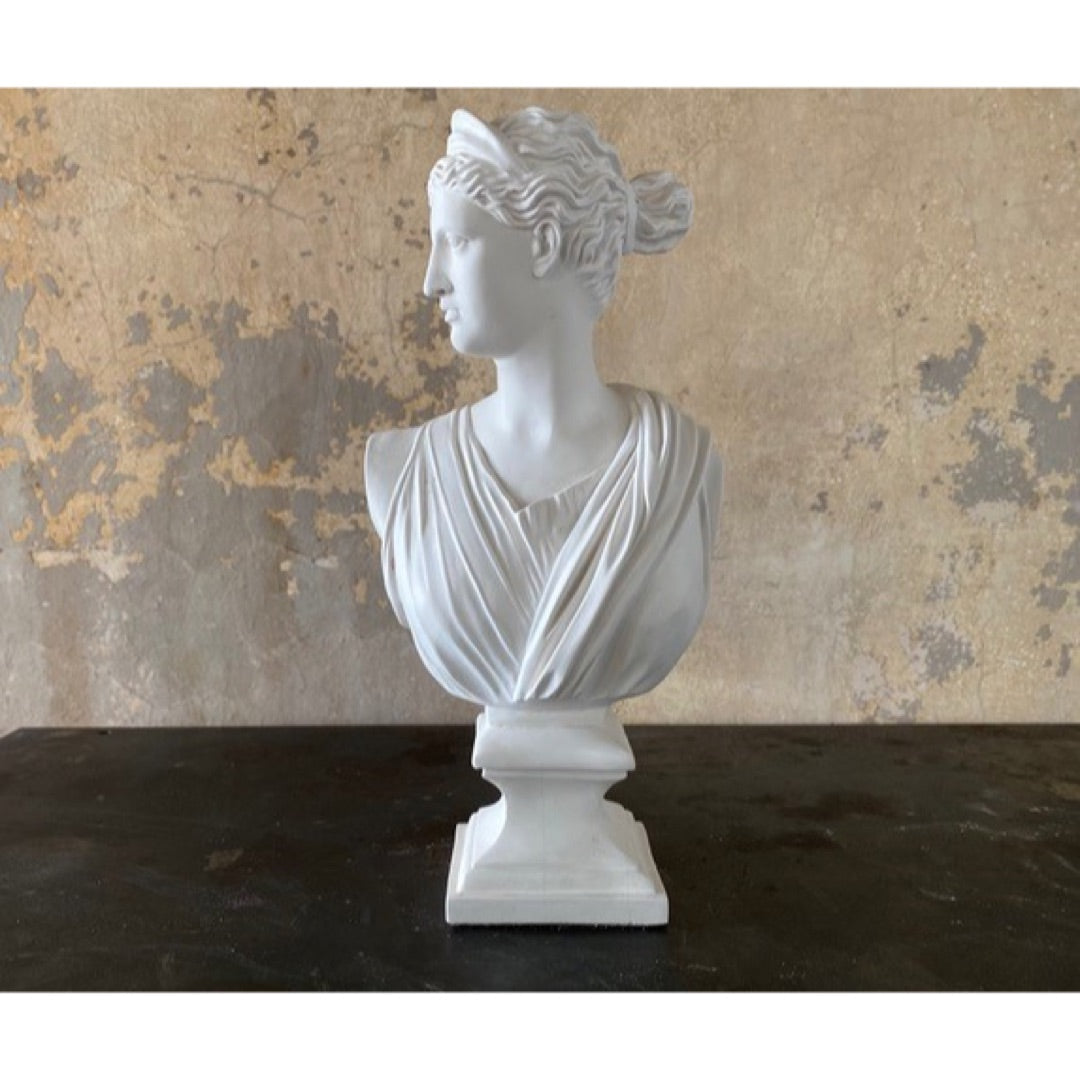
The Diana of Versailles, Reproduced as a Bust
This Diana of Versailles bust reproduces the head, neck, and shoulders of the huntress goddess. She is the twin counterpart to the Apollo Belvedere bust. Hair sweeps back from a wavy center part and gathers into a looped topknot at the crown. That hairstyle helps identify this Diana type. A chiton falls in a diagonal wrapped fold across the chest, sleeveless and ungathered at the shoulder. Cast in plaster and finished in white, this plaster bust replica sits on a stepped pedestal base.
At 23 in H, this Diana of Versailles bust matches the Apollo bust in scale and stand. The two display well as a pair. As a Diana statue bust rather than a full standing figure, it isolates just the face, hair, and shoulders.
Item Details
- Material: Hand cast plaster, white finish (variance in appearance may occur)
- Dimensions: 23 in. H x 11.5 in. W x 7 in. D
- Weight: 12 lb
- Production: Made to order in the USA, ready to ship in 2 to 3 weeks
- SKU: HP64520
- Related collection: Greek and Roman Collection
- Related collection: Statues Collection
History of the Original
As a Greek and Roman sculpture bust, this Diana continues the same display tradition as its Apollo counterpart. The Louvre Museum Diana is formally the Diana of Versailles. It is a marble carved in the 1st or 2nd century CE. It copies a Greek bronze made around 325 BCE. Many historians credit that lost bronze to the sculptor Leochares, the same attribution given to the Apollo Belvedere. Neither attribution is settled, and both rest on stylistic comparison rather than a signature. Pope Paul IV gave the statue to King Henry II of France in 1556. It stood first at the palace of Fontainebleau, then moved to the Louvre in 1602. Louis XIV later installed it in the Hall of Mirrors at Versailles in 1696. That move gave the statue its name. It is on view at the Louvre today.
Diana, and Why the Knot and Drape Matter
Diana was the Greek and Roman goddess of the moon and the hunt, and the twin sister of Apollo. She protected girls, watched over wildlife and the countryside, and guarded crossroads. Sculptors marked her with recurring attributes. Hair looped into a knot kept it clear of a bow. A short, unbound chiton allowed free movement. In the complete statue, Diana strides forward, reaching for an arrow, a hind at her side. This bust isolates the calm above that motion. Note the turned head, the swept hair, the fold of cloth at the collarbone. As classical bust decor, it reads as poised rather than active.
Display and Care
This bust displays well beside its Apollo companion, or alone on a desk, mantel, or bookshelf. Plaster is durable but porous. Keep it away from standing moisture. Dust it with a dry, soft cloth rather than water.
For More Reading


FAQs
Got a question? We are here to answer